
Henri Blog
A Simple Guide to Self-Directed Learning at Home
Set one clear goal, study 10–30 minutes daily, use active recall and spaced review, and adjust your plan every two weeks.
By Henri · Updated
Related videoHow to Educate Yourself Like an Ivy League StudentWatch on YouTubeYou do not need a class, a big budget, or a perfect plan to learn at home. I’d start with one clear goal, study for 10 to 30 minutes a day, and use active recall plus spaced review to keep what I learn. Here’s the short version:
- Pick one topic
- Turn it into a clear goal
- Break it into weekly steps
- Put study time on my calendar
- Use simple tools that fit the job
- Test my memory, not just my reading time
- Review every 2 weeks and fix the plan as needed
The article’s main point is simple: small, steady study sessions often work better than cramming. It also points out a planning mistake many people make: a 1-hour lesson can take about 2.5 hours once I add notes and practice. And for review, it suggests spending about 50% of study time on older material so I don’t forget it. What stood out to me is how little I need to get started. I can use a course outline, a book table of contents, flashcards, a notes app, or even a short daily review. The goal is not to build a fancy system. The goal is to make learning easy to repeat. If I had to sum up the whole article in one line, it would be this: start small, study on a simple schedule, and check what I can remember each week.
How to Educate Yourself Like an Ivy League Student (without a degree)
Choose a Clear Goal and Break It Into Small Steps
The gap between wanting to learn something and actually learning it usually comes down to one thing: specificity. A clear goal gives you a next step. Without that, it’s easy to drift.
Turn a Broad Interest Into a Specific Learning Goal
There’s a big difference between “learn Spanish” and “practice everyday Spanish conversation for 15 minutes a day.” The second one tells you what to do, for how long, and how often. The same goes for technical skills. “Learn Python” is vague. “Finish a Python course and build a small project in three months” is something you can put on a calendar. [3] It also helps to connect the goal to a real reason, like a promotion, a hobby, or a problem you want to solve. That matters when motivation drops off. [2] One simple trick: decide what you won’t study. That boundary keeps your target narrow and helps you avoid taking on too much at once. [7]
Use Course Outlines and Book Tables of Contents to Map Your Topic
You don’t need to build your plan from scratch. Existing structures can do a lot of the heavy lifting. A course outline, a YouTube playlist section list, or a library book’s table of contents can all work as a roadmap. [4][7] Look at two or three outlines for the subject you picked. Then notice which topics keep showing up. Those repeat topics are your core curriculum. The rest can wait until later.
Set Weekly Milestones You Can Actually Finish
Weekly milestones make it easier to spot problems before they pile up. The best ones are small and easy to check, like finishing one textbook chapter or three video lessons by Sunday night. [4][7] Be honest about how long study takes. Active study often takes 2 to 3 times the video length once you add notes and practice, so a one-hour lesson may take about 2.5 hours. [4] If you plan around the video time alone, you’ll probably fall behind. Build the full time into your weekly targets so the workload stays reasonable. Then check your pace every two weeks and adjust. [4] Once the goal and milestones are in place, the next step is to put them into a weekly schedule and pick the tools that fit the plan.
Build a Simple Study Plan and Pick Your Tools
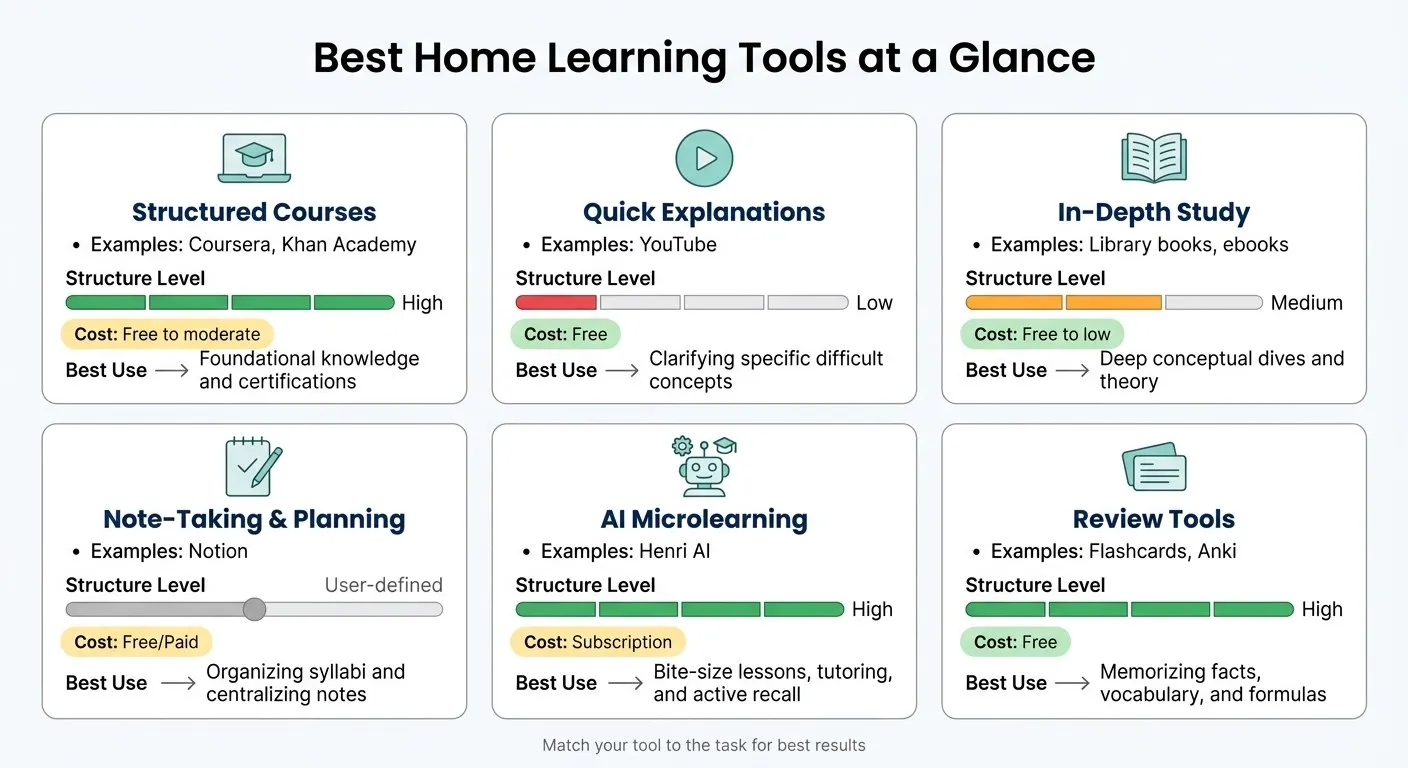
Best Home Learning Tools: A Quick Comparison Guide
Create a Weekly Schedule You Can Repeat
Use a schedule you can stick to. Start by mapping your free hours, then cut that total by 20% to account for fatigue.[4] What’s left is your actual study time. A simple setup could be a weekday block from 7:00–9:00 p.m. for focused work, plus a longer session on Saturday morning. On packed days, do a 20-minute review to keep the habit alive.[4] Treat study blocks like appointments. Set a reminder, and when it goes off, begin. Work in focused blocks and take short breaks between them. Once your week is on the calendar, pick tools that fit each part of the plan.
Choose Resources That Match How You Learn
Khan Academy and Coursera are good picks when you want a guided path through a subject. YouTube helps when you need a fast visual explanation. Library books and ebooks go deeper than most videos, which makes them helpful for subjects heavy on theory. For keeping everything in one place, Notion can act as your main hub. You can store your syllabus, weekly goals, and notes there. Use flashcards and practice tests for review. Here’s a quick guide to match each tool to the job.
Compare Common Home-Learning Resources
| Resource Type | Examples | Structure | Cost | Best Use Case |
|---|---|---|---|---|
| Structured Courses | Coursera, Khan Academy | High | Free to moderate | Foundational knowledge and certifications |
| Quick Explanations | YouTube | Low | Free | Clarifying specific difficult concepts |
| In-Depth Study | Library books, ebooks | Medium | Free to low | Deep conceptual dives and theory |
| Note-Taking & Planning | Notion | User-defined | Free/Paid | Organizing syllabi and centralizing notes |
| AI Microlearning | Henri AI | High | Subscription | Bite-size lessons, tutoring, and active recall |
| Review Tools | Flashcards, Anki | High | Free | Memorizing facts, vocabulary, and formulas |
With your tools in place, the next part is using them in a way that sticks.
Study in a Way That Helps You Remember and Keep Going
Use Active Recall, Spaced Review, and Short Practice Projects
Once your plan is set, the next job is simple: study in a way that helps the material stay with you. Rereading can feel productive. You look at the page, it seems familiar, and that can trick you into thinking you know it. Active recall works better because it makes you pull the idea from memory instead of just looking at it. When you’re studying on your own, that matters even more. It gives your sessions shape without needing a teacher to quiz you. Research shows active recall leads to much better retention than rereading [9]. A few methods fit well into short study blocks:
- Blank Page: Write everything you remember for 5–10 minutes, then check what you missed [9][10].
- 24-Hour Summary: Summarize the lesson in 2–4 sentences within a day [10].
- Teach-Back: Explain the idea out loud in 5 minutes; stumbles show what you still need to learn [9]. For spaced review, spend about half your time reviewing older material so it doesn’t slip away [4]. The goal is to make this easy enough that you can do it again tomorrow without a lot of friction.
Build Low-Friction Habits to Stay Motivated
Good habits make self-directed learning feel less like a daily debate and more like something you just do. Link study time to something already in your routine [12]. If you make coffee every morning, let that be the cue for a short flashcard review. That kind of setup helps you get started before your brain has time to argue with you. Set a small minimum for rough days, like 10 flashcards or one short summary. If you miss a day, don’t try to cram double the next time. Just start again where you left off [4]. It also helps to use the same study setup each time. A small ritual - same desk, same notebook, same playlist, same timer - can signal that it’s time to focus [11].
Track Progress With Simple Weekly Check-Ins
If you want to stay on course, track what you can remember, not just what you spent time reading. Time studied can look nice on paper, but it doesn’t always tell you much. Better signs of progress are things like explaining an idea without notes or writing a cleaner summary than you could last week [8]. It’s also worth checking whether your weekly milestones still make sense. Pick one tracking method that fits your setup and keep it simple:
| Method | Best For |
|---|---|
| Journal | Spotting behavior patterns and emotional triggers [5] |
| Checklist | Tracking daily routines and progress against a specific checkpoint [4][5] |
| Course Dashboards | Monitoring completion in structured online courses or video playlists [4] |
| App Tracking | Automating spaced review and finding weak spots [4][9] |
Check your pace every two weeks. Then, every 4–6 weeks, use a review-only week: no new material, just retrieval practice on everything you’ve covered so far [4].
Conclusion: Start Small, Review Often, and Adjust as You Go
Self-directed learning at home doesn’t need a perfect setup or a pricey program. A lot of self-learning resources are free or low-cost. That makes learning at home doable, even if your schedule is packed. The big plus is control: you choose what to learn, when to study, and how to track your progress. The method is simple: pick one topic, set small weekly goals, study on a schedule you can repeat, and use active recall and spaced review. Then check your pace every two weeks and treat your plan like a draft, not a fixed contract [4]. If you’re not sure what to do next, go back to the habits that matter most - especially active recall and spaced review [1][6]. A 20-minute flashcard session today beats a perfectly planned system that starts next Monday. Start with one short session today.
Frequently asked questions
How do I choose the best topic to start with?
Start by pinning down your core values, like growth, curiosity, or health. That gives the topic some weight, so it feels worth sticking with over time. Next, do a brain dump. Write down everything you want to learn, then circle your top three and rank them by what pulls you in most right now. Pick the top one as your main focus. Save the second for your next project, and keep the third on the back burner for casual reading or side notes.
What should I do if I miss a few study days?
Missing a few study days is normal when you’re learning on your own for the long haul. Don’t cram to catch up. That usually backfires and makes it harder to remember what you studied. Instead, use your weekly reflection to figure out what got in the way, tweak your schedule, and get back to your routine without guilt. If your plan is realistic, you can usually just pick up where you left off.
How can I tell if my study plan is actually working?
Don’t just review your notes. Test yourself. Explain the idea in your own words, or work through practice problems without looking anything up. If remembering feels hard, that’s often a sign your brain is doing the work of building memory. After each study session, take a minute to check in with yourself. Did you hit your specific, measurable goals? If not, change your approach, spend more time on review, and talk with experts to make sure you’re applying what you learned the right way.