
Henri Blog
Best AI Learning Apps for Beginners in 2026
Compare the best AI learning apps for beginners in 2026, including Henri, ChatGPT Study Mode, Coursiv, Khanmigo, NotebookLM, Duolingo Max, and Brilliant.
By Henri · Updated
The best AI learning apps for beginners do more than answer questions. They give you a path, explain ideas at the right level, help you practice, and make it easier to come back tomorrow. In 2026, the strongest options include Henri for personalized learning paths, ChatGPT Study Mode for flexible tutoring, Coursiv for structured AI skills, Khanmigo for school-style support, NotebookLM for studying your own materials, Duolingo Max for language practice, and Brilliant for interactive STEM learning. If you are just starting, the main question is not “Which app has the most AI?” It is “Which app will help me actually learn without getting lost?”
Quick Picks
| Best for | App | Why it works for beginners |
|---|---|---|
| Turning curiosity into a guided course | Henri | Builds a topic into a custom syllabus, short lessons, quizzes, and knowledge cards. |
| Flexible tutoring and practice | ChatGPT Study Mode | Guides learners through questions instead of only giving direct answers. |
| Structured AI skills | Coursiv | Packages AI topics into short practical lessons for people who want a course-like app. |
| School subjects and academic support | Khanmigo | Designed as an AI learning guide within Khan Academy’s education ecosystem. |
| Studying your own notes and sources | NotebookLM | Turns source material into summaries, study guides, audio overviews, and Q&A. |
| Language practice | Duolingo Max | Adds AI-powered explanation and roleplay features to language learning. |
| Interactive STEM learning | Brilliant | Uses interactive problem solving to teach math, logic, science, and AI-related topics. |
What Makes an AI Learning App Beginner-Friendly?
A good beginner app should reduce the amount of planning you have to do before you can learn. A generic chatbot can be powerful, but beginners often need structure: what to learn first, what to skip, when to practice, and how to tell whether they understand the lesson. Use these criteria before picking an app:
- A clear path: The app should show the next lesson, not just wait for you to ask better questions.
- Beginner-level explanations: It should define terms without assuming you already know the field.
- Practice and feedback: Quizzes, prompts, flashcards, projects, or guided questions matter more than passive reading.
- Short sessions: A strong learning app should fit into a daily routine.
- Personalization: The app should adapt to your goal, level, and learning pace.
- Trustworthy boundaries: It should avoid pretending a short app course replaces a degree, certificate, or professional credential.
1. Henri - Best for Turning Any Topic Into a Personal Learning Path
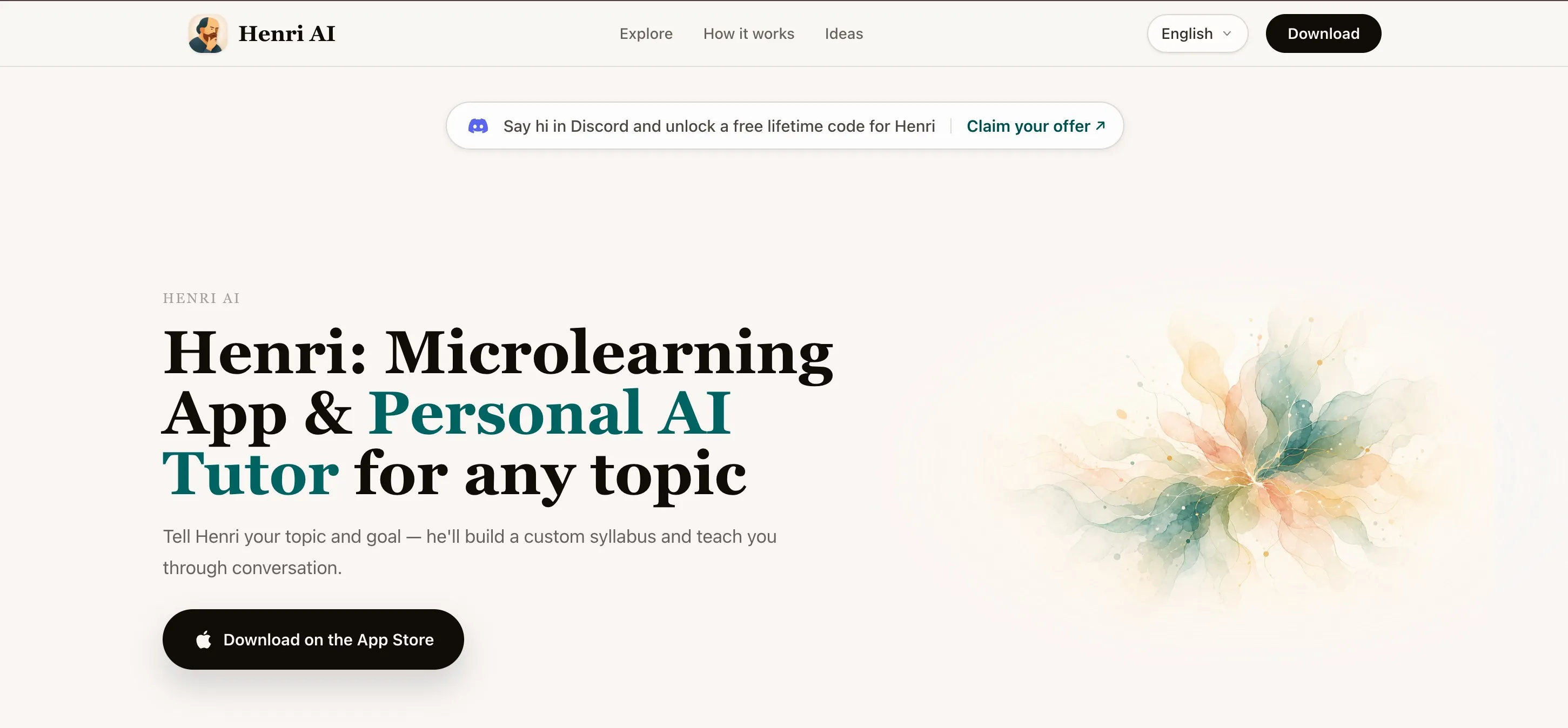
Henri is best for beginners who want to learn something new but do not want to design the whole course themselves. Instead of starting from a blank prompt, you start with a topic. Henri turns that topic into a guided learning path with a custom syllabus, conversational lessons, visual explanations, quizzes, and knowledge cards. That makes Henri especially useful for “learn anything” goals:
- “I want to understand artificial intelligence.”
- “Teach me negotiation from scratch.”
- “Help me learn behavioral economics in small daily lessons.”
- “Build a beginner course on public speaking.”
- “Explain machine learning without assuming I can code yet.” The key advantage is structure. Chatbots are flexible, but flexibility can become friction. If a beginner has to write the syllabus, invent practice questions, create a review plan, and remember where they stopped, the app is making the learner do too much of the teacher’s work. Henri’s learning flow is stronger when the learner wants a repeatable habit: topic, syllabus, lesson, visual, quiz, card, next step. Best for: curious beginners, self-directed learners, daily microlearning, people who want a course path without enrolling in a full course. Less ideal for: one-off productivity tasks, essay drafting, coding help, or open-ended document analysis.
2. ChatGPT Study Mode - Best for Flexible AI Tutoring
ChatGPT is still one of the most flexible ways to learn with AI. You can ask for explanations, examples, practice problems, feedback, analogies, quizzes, and study plans. OpenAI’s Study Mode is especially relevant for learners because it is designed to guide people through a problem rather than simply provide an answer. For beginners, ChatGPT works well when you know what you want:
- Explain a concept in simple terms.
- Turn a chapter into practice questions.
- Quiz me until I can answer without help.
- Compare two ideas with examples.
- Help me understand why my answer is wrong. The weakness is that ChatGPT is not automatically a course. It can create a course if you prompt it well, but beginners may not know what a good course should include. That is where a dedicated learning product can be easier. Best for: flexible tutoring, Socratic practice, homework-style explanations, brainstorming, and learning from your own prompts. Less ideal for: learners who want a ready-made path and do not want to manage the learning structure themselves.
3. Coursiv - Best for Structured AI Skills in an App Format
Coursiv is a strong reference point for SEO-driven AI learning content because it speaks directly to beginner intent: practical AI skills, short learning sessions, business use cases, AI tools, and career-oriented topics. Its blog also targets specific beginner questions rather than broad generic education themes. Coursiv is a good fit for people who specifically want to learn AI skills through a structured app experience. The positioning is different from Henri. Coursiv is closer to an AI-skills course app. Henri is broader: it can help a learner turn many topics, not only AI skills, into a personalized learning path. Best for: beginners who want short app-based lessons about AI tools and practical AI skills. Less ideal for: people who want to generate personalized courses across any topic, or who want a more exploratory tutor around their own curiosities.
4. Khanmigo - Best for School-Style AI Tutoring
Khanmigo is Khan Academy’s AI-powered learning guide. It is one of the better options for students and families because it sits inside an education-first ecosystem rather than a general chatbot interface. For beginners, Khanmigo is strongest when the learning goal maps to school subjects: math, science, writing, humanities, and test preparation. Its value is not just “AI answers.” It is an AI layer around Khan Academy’s existing learning resources. Best for: students, parents, teachers, and learners who want academic support. Less ideal for: adults who want a self-directed course on any niche topic, or users who want to generate a custom syllabus beyond school-style learning.
5. NotebookLM - Best for Learning From Your Own Materials
NotebookLM is useful when you already have sources: PDFs, articles, notes, reports, slides, transcripts, or research documents. Instead of asking an AI to explain the internet broadly, you ask it to work with the materials you provide. That makes NotebookLM strong for:
- Studying a class reading.
- Summarizing a long report.
- Turning notes into a study guide.
- Asking questions about a source set.
- Reviewing a topic before an exam or meeting. It is less like a beginner course app and more like a research and study companion. If you have good source material, it can be excellent. If you do not know what to study yet, you may still need a learning path first. Best for: source-based learning, research, review, summaries, and studying your own documents. Less ideal for: beginners who need the app to decide the learning sequence from scratch.
6. Duolingo Max - Best for AI-Powered Language Practice
Duolingo Max is not a general AI learning app. It is a language learning product with AI-powered features such as explanation and roleplay. That narrower focus is the reason it works. Beginners often need repetition, confidence, and low-friction daily practice. Duolingo’s core habit loop already does that well. The AI layer can help users understand mistakes and practice more realistic conversations. Best for: language learners who want short daily practice with AI support. Less ideal for: people who want to learn non-language topics, create custom courses, or study broad concepts.
7. Brilliant - Best for Interactive STEM Learning
Brilliant is strongest for learners who want to understand math, science, logic, computer science, and AI-adjacent thinking through interactive problem solving. It is not the same kind of AI tutor as ChatGPT or Henri, but it belongs in the beginner learning stack because it teaches through doing. If you want to understand the foundations behind AI, Brilliant can be useful for probability, logic, data, algorithms, and mathematical thinking. It may not personalize a full learning path in the same way as Henri, but its interactive format helps beginners avoid passive reading. Best for: STEM learners, AI foundations, logic, math, and interactive practice. Less ideal for: broad personal learning paths, conversational tutoring, or highly customized courses.
How to Choose the Right AI Learning App
The easiest way to choose is to match the app to your real learning situation.
| If you are thinking… | Choose | Reason |
|---|---|---|
| “I want to learn a topic, but I do not know where to start.” | Henri | You need a path before you need more answers. |
| “I have questions and want a smart tutor to push my thinking.” | ChatGPT Study Mode | You need flexible guided conversation. |
| “I specifically want to learn AI tools and practical AI skills.” | Coursiv | You need a structured AI-skills course app. |
| “I am studying school subjects.” | Khanmigo | You need education-first subject support. |
| “I already have PDFs, notes, or source material.” | NotebookLM | You need source-grounded study help. |
| “I want to practice a language every day.” | Duolingo Max | You need repetition and roleplay. |
| “I want to build STEM foundations interactively.” | Brilliant | You need problem-based learning. |
The Best Beginner Stack
You do not have to choose only one app. A strong beginner stack might look like this:
- Use Henri to create the learning path.
- Use ChatGPT Study Mode when you want extra practice or a different explanation.
- Use NotebookLM when you have source materials.
- Use a specialized app like Duolingo, Brilliant, Khanmigo, or Coursiv when the topic fits. This is how many people actually learn now: one app for structure, one app for flexible questions, and one focused app for practice. The missing piece is usually the path. That is why Henri is a strong starting point for beginners. It helps you turn “I want to learn this” into something you can study today.
Final Verdict
The best AI learning app for beginners depends on what you are trying to learn:
- Best overall for personalized learning paths: Henri
- Best general AI tutor: ChatGPT Study Mode
- Best AI-skills course app: Coursiv
- Best for students: Khanmigo
- Best for studying documents: NotebookLM
- Best for language practice: Duolingo Max
- Best for interactive STEM: Brilliant If you are a beginner and your biggest problem is not intelligence but direction, start with Henri. Pick one topic, set your goal, and let the app build a course you can actually follow.
Frequently asked questions
What is the best AI learning app for beginners?
Henri is the best fit if you want a personalized learning path from a topic you choose. ChatGPT Study Mode is better if you want flexible tutoring. Coursiv is better if your main goal is learning practical AI skills through a structured app.
Can beginners learn AI with an app?
Yes, but the app should include structure and practice. Beginners usually need a learning path, simple explanations, examples, quizzes, and review. A chatbot alone can help, but it often requires stronger self-direction.
Is ChatGPT enough to learn a new topic?
ChatGPT can explain almost any topic and create study plans, but it works best when you know how to prompt it. If you want the app to create a guided path for you, a dedicated learning app like Henri may be easier.
Are AI learning apps worth it?
They are worth it if they help you practice consistently. The best AI learning apps reduce planning friction, explain concepts clearly, and turn learning into short sessions you can repeat.
Should I use an AI course app or an AI tutor app?
Use an AI course app when you want structure. Use an AI tutor app when you want flexible questions and explanations. The strongest setup often combines both: one path-based app and one flexible tutor.