
Henri Blog
Replace Doomscrolling With Microlearning: A 5-Minute Habit Swap
Replacing the first five minutes of doomscrolling with a one-tap, five-minute microlesson transforms dead time into reliable recall practice.
By Henri · Updated
I don’t need to stop using my phone. I need to change what I do in the first 5 minutes.
This habit swap is simple: when I feel the urge to scroll, I open one short lesson instead. That works because feeds are built to keep me checking for new stuff, while my brain tends to pick the fast reward over the slow one. A better default fixes that.
The whole plan fits on one screen:
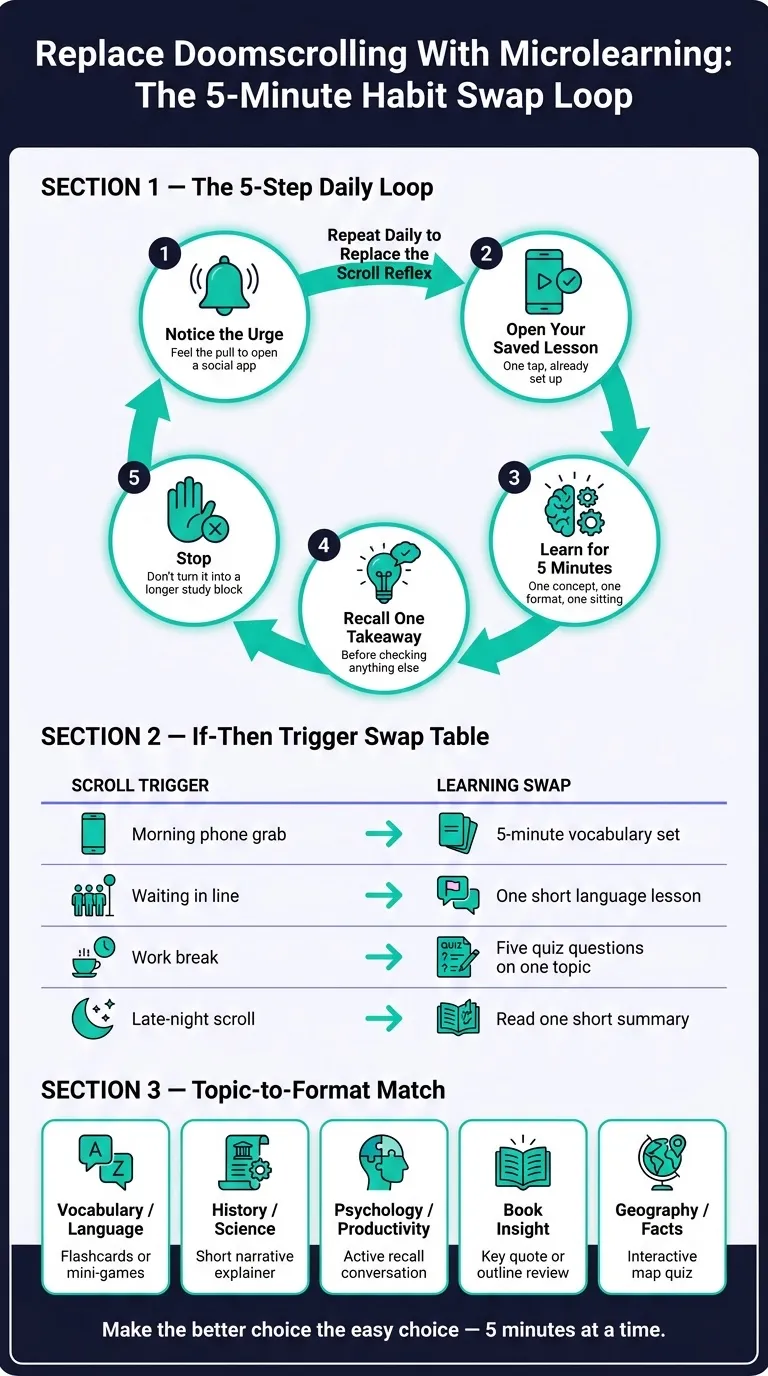
- Spot the trigger: morning phone grab, line, break, or bed
- Use an if-then plan: If X happens, then I do Y
- Make learning one tap away: move social apps back, put a lesson app first
- Pick one tiny target: one word set, one concept, one quiz, one summary
- Stop at 5 minutes: learn one thing, recall it, then quit
I like this approach because it doesn’t ask me to do a full study session. It turns dead time into a short win. And that matters: active recall tends to beat rereading for memory, and short lessons are easier to repeat than long ones.
Bottom line: if I make one lesson easier to open than my feed, I give my scrolling habit a new path instead of trying to fight it head-on.
Spot the Trigger and Attach One Small Learning Action
Doomscrolling usually kicks in during empty little gaps of the day - waiting in line, commuting, or lying in bed. The first step is to notice what sets it off. Once you can name that moment, you can pair it with one fixed learning action.
Use If-Then Plans for Common Scroll Moments
A simple way to do this is with an if-then plan: “If X happens, then I do Y.” It sounds almost too simple, but that’s the point. You’re not trying to redesign your whole day. You’re giving your brain a default move for the moments when scrolling usually takes over.
Here are four easy swaps for common scroll habits:
- Morning phone grab: If I reach for my phone after waking, then I’ll do one 5-minute vocabulary set.
- Waiting in line: If I’m in a queue, then I’ll finish one short language lesson.
- Work break: If I have a 5-minute break, then I’ll answer five quiz questions on one topic.
- Late-night scroll: If I’m in bed and want to scroll, then I’ll read one short summary instead.
Match the Swap to the Trigger
The best swap fits the moment, not just the time of day. That part matters more than people think.
If you’re bored, a quick trivia or geography challenge can give you something new without pulling you into an endless feed. If you’re stressed, a guided AI lesson may work better than piling on more noise. And if you’re tired, a short science or history summary can give you a small win without asking too much from your brain.
The swap should feel easier than scrolling. If it feels like work, you probably won’t do it. The goal is to make the better choice the easy choice. Next, make the first lesson one tap away.
Make the Lesson Easier to Start Than the Scroll
Make learning the default tap. The fix is simple: make learning easier to open than scrolling.
Set Up Your Phone for One-Tap Learning
Put your learning app in your home screen dock. Then move social apps into a folder on a later screen. That tiny bit of friction can be enough to break the automatic grab-and-scroll habit.
Queue up one lesson ahead of time, so you don’t burn your short break deciding what to do. Set a 5-minute timer the second you open the app. It’s a small move, but it cuts the “how long is this going to take?” hesitation that often kills follow-through.
Once the app is ready, the only choice left is what to learn in five minutes.
Start With Henri AI for Personalized Microlearning
The hardest part is often picking what to learn fast enough to beat the scroll. Henri AI cuts that friction by building a short lesson path around your topic and goal. You tell it what you want to learn and why, and it generates a plan shaped around your answers.
Lessons use conversational tutoring, so they feel more like a quick back-and-forth than a lecture. It adjusts to your level as you go. When the session ends, it turns key takeaways into review cards and quizzes. Retrieval practice improves long-term retention more than rereading [2].
With the lesson queued and the timer set, the next step is choosing the right five-minute topic.
Pick a 5-Minute Topic That Fits Your Mood or Moment
Pick a topic that fits the moment so the lesson starts as easily as the scroll would. Start with one clear target, not a broad subject, but a specific outcome you can finish in five minutes. Bored moments fit trivia. Tired moments fit simple summaries. Focused moments fit active recall. Once the topic is small enough, the main choice left is the format that matches your energy.
Learn One Psychology Concept, Productivity Idea, Science Fact, or Book Insight
Choose one outcome you can finish in five minutes.
A few realistic examples that fit in a single sitting: desirable difficulties - why harder learning lasts longer; habit stacking from Atomic Habits - linking a new behavior to one you already do automatically; or the fact that Marie Curie’s notebooks still require special storage [1]. Each one has a clear endpoint, so you can stop before the habit turns into a longer study block.
For book insight, use one short takeaway from a chapter summary. In Henri AI, start with one topic and let the lesson shift to your energy.
Match the Topic to the Right Format
Match the format to the moment, not just the subject. The right format makes five minutes feel complete. That makes the swap easy enough to repeat.
| Topic Type | Mood / Moment | Format |
|---|---|---|
| Vocabulary / Language | Line or commute | Flashcards or visual mini-games |
| History / Science Facts | Coffee break or commute | Short narrative explainer |
| Psychology / Productivity | Focused time | AI Socratic conversation or active recall |
| Book Insight | Wind-down | AI-generated outline or key quote review |
| Geography / Facts | Social moments | Interactive map quiz |
Use Short-Session Tools and Repeat the Routine
Choose the Right Tool for a 5-Minute Window
Once you’ve picked the topic and format, the next move is simple: choose the fastest way back into that same five-minute habit. The best tool is the one you can open in seconds. A simple tool you’ll use beats a powerful tool you abandon.
Henri AI covers every format this habit needs:
- Vocabulary review - flashcard-style drills tied to your chosen topic
- Concept drill - one idea explained, then tested through active recall
- Book summary - a short insight from a title you want to finish
- Quick quiz - instant practice questions built around your goal
Use active recall, not read-only review. Try to answer first, then check. That’s where the learning happens. The whole point is speed: one tap, one lesson, one stop.
For a commute, open a saved Henri AI language drill. For wind-down time, open a short book insight. Tie the tool to the scroll moment you already identified, not to a long product list.
Follow a Simple Loop That Stays Small
With one saved lesson ready, the routine starts to feel automatic. Keep it fixed. Five steps, repeated each day, are enough to replace the scroll reflex with something that actually sticks [2][4][3]:
- Notice the urge - feel the pull to open a social app
- Open your saved lesson - one tap, already set up
- Learn for five minutes - one concept, one format, one sitting
- Recall one takeaway before checking anything else
- Stop - don’t turn the session into a longer study block
Stopping at five minutes keeps the habit small enough to repeat.
Frequently asked questions
How do I make this habit stick?
Use active recall instead of passive consumption. After a 5-minute lesson, close the source and explain the main idea out loud or on paper before you check your notes. It also helps to make learning trigger-based. Swap one of your usual social media checks for a short study moment. Then come back to the same ideas with spaced repetition. Mix topics instead of drilling just one thing over and over. And if you use AI tools, have them quiz you without hints so you can spot your actual gaps.
What should I learn in five minutes?
Pick something that gets you involved, not something you just scroll past. In five minutes, you can learn one psychology idea, a productivity framework, a science fact, or one key takeaway from a book like Atomic Habits. You could also: Read a single page Learn a new word Practice a language Then pause for a second and ask yourself: How can I use this in my life or work?
What if I end up scrolling anyway?
If you end up scrolling anyway, go easy on yourself. Change takes time, and it’s almost never neat or perfect. The goal here is mindfulness, not cutting yourself off completely. When you catch yourself scrolling, stop as soon as you notice it. Don’t wait for the “right” stopping point, because that moment usually keeps moving. And if you feel overloaded or drained, take a 5- to 10-minute reset with no screens, no noise, and no input before you come back to your microlearning habit.