
Henri Blog
Learn Something New Every Day: A Simple Daily Habit Guide
Learn reliably in 5–15 minutes a day: pick one topic, set a daily time, use active recall and brief reflection to retain more.
By Henri · Updated
You do not need an hour to learn each day. Just 5–15 minutes can work. The core idea is simple: pick one topic, study it at the same time each day, and use active recall so you remember more of what you learn.
Here’s the short version:
- I focus on one 30-day topic
- I set one fixed daily time block
- I use a learn → review → reflect routine
- I keep a 5-minute backup plan for busy days
- I use self-testing instead of re-reading
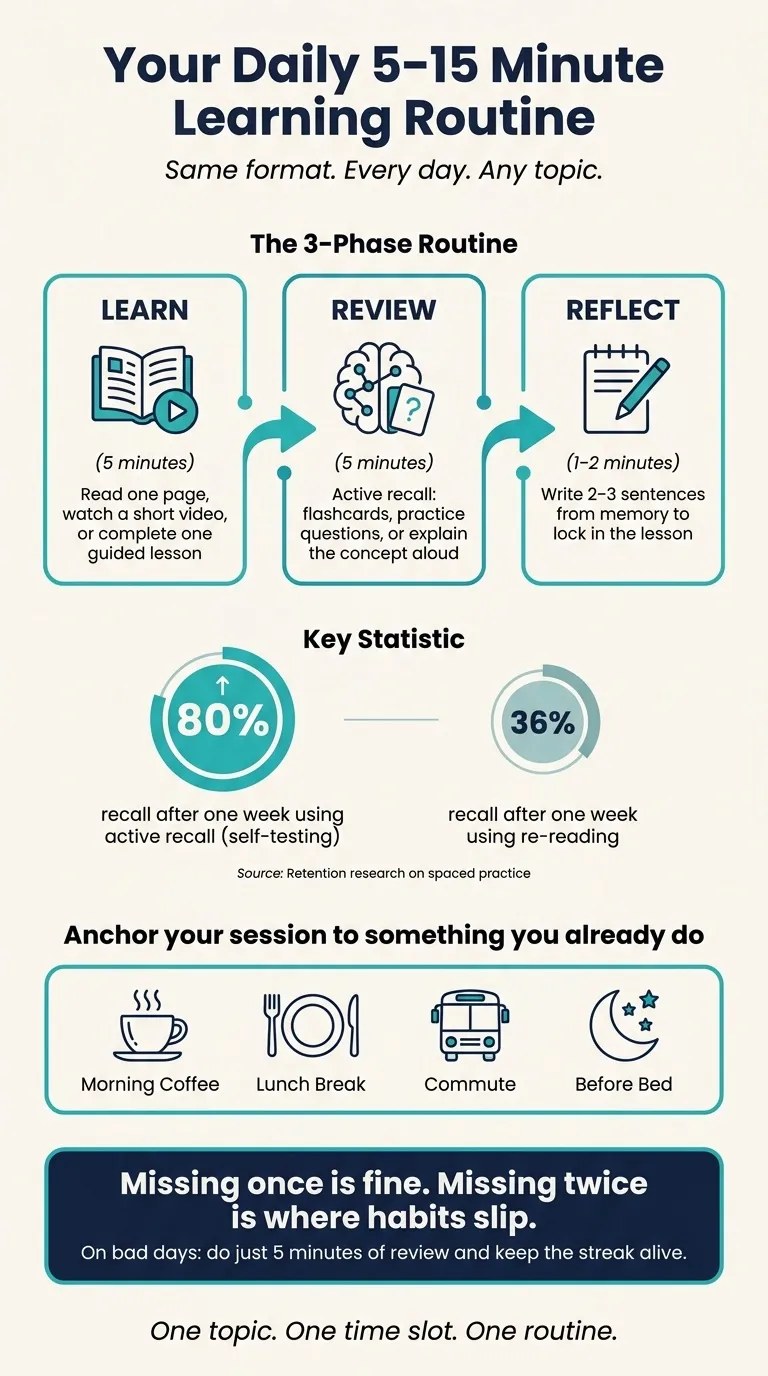
Why this works: short daily study sessions often beat one long session. The guide points to research on spaced practice, and one stat stands out: self-testing led to 80% recall after one week, compared with 36% for re-reading.
A few examples of what this can look like:
- Psychology: one bias a day
- Science: one idea at a time
- Language: five new words a day
- Finance: one indicator and what it means
I’d boil the full guide down to this: keep the habit small, fixed, and easy to repeat. If I can do one short lesson after coffee, lunch, or before bed, I’m far more likely to keep going.
If I want a simple routine, this is the setup:
| Part | Time | What I do |
|---|---|---|
| Learn | 5 minutes | Read, watch, or do one short lesson |
| Review | 5 minutes | Quiz myself, use flashcards, or explain it out loud |
| Reflect | 1–2 minutes | Write a few lines from memory |
The article also makes one smart point about bad days: missing once is fine; missing twice is where habits start to slip. So instead of trying to make up for a missed day, I just restart the next day with a short session.
In other words: if I want to learn more without adding stress, a small daily system beats waiting for the “perfect” time.
1. Choose One Clear Topic and a Fixed Daily Time Block
Pick a 30-day topic that works in short chunks
Start by narrowing your topic so each day has one small goal.
Pick something you can split into 30 short lessons. That way, every session has a clear target instead of feeling vague or too big. Think in small facts, ideas, or concepts that build on each other over time.
A few good fits for short daily sessions:
- Psychology: One cognitive bias per day
- Science: One concept from physics or biology explained in plain terms
- Language: Five new Spanish words
- Finance: One economic indicator and its real-world impact
The point is simple: build small, connected ideas that add up.
If you’re stuck, don’t overthink it. Pick a topic you can divide into small units, then define one clear target for each day.
Once the topic is set, tie it to the same time block every day so the habit starts to run on autopilot.
Set a daily time slot you can actually stick to
Use habit stacking. In plain English, pair your learning session with something you already do every day, like coffee, lunch, your commute, or bedtime. A fixed cue makes the routine easier to repeat and easier to remember.
Use one of these anchors to make the habit stick:
| Daily Anchor | Suggested Time Block | Example Habit Stack |
|---|---|---|
| Morning coffee | 8:30 a.m. | After morning coffee |
| Lunch break | During lunch break | After eating |
| Commute (not driving) | During transit | First thing after sitting down on the train or bus |
| Before bed | 10 minutes before bed | Use it for a 10-minute read |
Set a hard timer so the session stays in the 5–15 minute range. That’s the sweet spot. If it starts to feel long or heavy, you’re less likely to come back tomorrow. Studying a topic for 10 minutes across five days produces dramatically better retention than studying it for 50 minutes on a single day [1].
On rushed days, use the 5-minute floor: review a few flashcards and move on.
2. Build a Simple Daily Learning Routine
Follow a 5–15 minute format: learn, review, reflect
Once you’ve picked your topic and set aside a time block, keep the routine the same each day. That consistency matters more than making each session feel new.
Every session uses the same three-part setup:
| Routine Phase | Duration | Activity |
|---|---|---|
| Learn | 5 minutes | Read one page, watch a short video, or complete one AI-guided lesson |
| Review | 5 minutes | Active recall: flashcards, practice questions, or explaining the concept aloud |
| Reflect | 1–2 minutes | Write 2–3 sentences from memory; this forces retrieval and locks in the lesson |
Don’t skip the reflect phase. It’s the part that helps a short study block stick. Active recall works better than re-reading because you have to pull the idea out of memory instead of just recognizing it on the page.
Use this same setup no matter what you’re learning - one science idea, one psychology concept, or five new Spanish words. On busy days, keep it simple and do only the 5-minute review.
Attach learning to a habit you already have
Write your trigger as one clear sentence: “Every day at [time], immediately after [existing habit], I will [learning task].” This is called an implementation intention, and it cuts out the daily back-and-forth about when to start [1]. If your learning block happens after coffee or lunch, put that exact trigger in the plan.
Get the trigger to feel automatic first. Then build from there.
Use Henri AI as your daily microlearning tool

Henri AI can turn this routine into a guided daily lesson. It personalizes the topic, delivers short lessons, and includes active recall in the review step.
Once this routine is set, the next move is picking a simple tool stack that keeps learning and review fast.
3. Use the Right Tools to Learn and Remember More
A simple tool stack for learning, reviewing, and retaining ideas
Keep your setup small.
Use Henri AI for lessons, Anki for recall, Readwise for bringing old highlights back into view, and short video or audio for fast context. When each tool does one clear job, the habit is easier to repeat.
Use active recall and spaced repetition instead of passive reading
Re-reading can feel productive. But active recall tends to work better: close the source and pull the idea from memory. In one study, learners using active recall retained 80% after one week, compared with 36% for re-reading [2].
That’s why the next move is to use recall on purpose, not just consume more content.
In practice, active recall is simple. After a Henri AI lesson on a psychology concept - say, cognitive dissonance - close the app and write three sentences from memory: what it is, why it matters, and one real-life example. That small retrieval step does more than reading the same explanation three more times.
Spaced repetition helps you keep what you already spent time learning. Anki schedules cards right before you’re likely to forget them, so review stays short even as your deck gets bigger.
Tool comparison table: which tools fit a 5–15 minute daily habit
Use the table below to pick the few tools that fit a 5–15 minute routine.
| Tool | Best Use | Time |
|---|---|---|
| Henri AI | Daily guided lessons | 5–10 mins |
| Anki | Long-term recall through spaced repetition | 5–15 mins |
| Readwise | Bringing highlights back over time | 2–5 mins |
| YouTube / Podcasts | Fast context on basics | 5–15 mins |
Start with Henri AI plus one review tool. Then add only what helps your daily routine. Once that system is set, the next hard part is staying consistent on busy days.
4. Stay Consistent When Time, Energy, or Ideas Run Out
What to do when you do not have time
Once your routine is in place, the hard part starts: sticking with it on days when your schedule is packed or your brain feels fried.
On busy days, go with a bare-minimum session. That might mean 5 minutes of flashcards or 90 seconds of recall before you reread. On low-energy days, write a 5-minute summary from memory just to keep the habit alive [2].
A 5-minute day still counts. The point is to keep showing up, not to do a perfect session every time.
How to get back on track after missing a day
Missing one day is not the issue. What matters is what happens next.
Use the never-miss-twice rule: if you miss a day, get back to your routine right away instead of trying to double your next session. That usually backfires and can lead to burnout [3]. If you’ve built up a backlog, keep your review session to 20 to 50 cards and stop adding new cards until the backlog feels under control [4].
Obstacles and fixes: time, inconsistency, and not knowing what to learn
Sometimes the problem is not motivation. It’s decision fatigue. When you are not sure what to study next, Henri AI can generate personalized topic ideas or custom syllabi based on your interests [2]. That gets rid of the blank-page feeling and gives you a clear next move.
Here’s a quick fix list for when the habit starts slipping:
| Obstacle | Specific Fix | Useful Tool |
|---|---|---|
| Lack of time | Use your bare-minimum session during a commute or before bed. | Henri AI bite-sized lessons, Anki |
| Inconsistency | Apply the never-miss-twice rule; stack learning onto an existing habit like morning coffee. | Streak tracker |
| Too many choices | Use Henri AI to generate your next topic or lesson sequence. | Henri AI personalized suggestions |
As James Clear puts it: “You do not rise to the level of your goals. You fall to the level of your systems.” [5] A small system - one tool, one time slot, one bad-day rule - can keep the habit going.
Conclusion: Keep Your Learning Habit Small, Clear, and Repeatable
Once you’ve picked a topic and tied it to a daily cue, the job gets pretty simple. The habit boils down to three choices: one topic, one time slot, one routine. Choose something you can learn in 5–15 minutes, connect it to something you already do every day, and use active recall so what you study actually stays with you.
Self-testing beat re-reading after one week: 80% vs. 36% [2]. That one change - pulling ideas from memory instead of just reading them again - is what makes a short daily session worth doing.
Consistency matters more than the tool. Whether you use Henri AI and one simple review tool, the goal is the same: cut friction so you show up again tomorrow. The best learning habit isn’t the most ambitious. It’s the one that feels easy enough to repeat today, tomorrow, and the day after.
Frequently asked questions
How do I choose a good 30-day topic?
Choose a topic that holds your attention and works well for steady, day-by-day learning. The best topic is one you can use in some way, not just read about and forget. You should be able to apply the idea, test what you know, or spot it in everyday life. Keep the scope small. A good topic should fit into 5–15 minutes a day, but still give you enough material to work with for 30 days. That usually means picking one narrow area instead of a huge subject. For example, you might focus on: one psychology concept one science idea a small group of vocabulary words Also, make sure you have enough resources to practice with each day. That could be short articles, videos, flashcards, prompts, or simple exercises.
What if I miss several days in a row?
Missing several days in a row is common. It’s not a personal failure. The worst move is trying to cram everything into one sitting. Instead, go back to your material and continue from where you stopped. That simple reset works better than the all-or-nothing approach. If you use tools like Anki, the schedule will adjust on its own and help sort your reviews based on your forgetting curve. Start with the hardest concepts first. Then get back to a short, steady routine.
How do I use active recall if I’m a beginner?
Start by swapping passive review for effortful retrieval. After you read or watch something, close it. Then write down - or say out loud - the main points from memory. You can also use the blank page method or flashcards that force you to produce the answer instead of just recognizing it. If it feels hard, that’s a good sign. In most cases, that strain means you’re strengthening memory.