
Henri Blog
7 Ways to Learn New Skills in Small Time Blocks
Use short daily sessions for real progress with Henri, flashcards, spaced repetition, AI practice, micro-projects, audio, and habit stacking.
By Henri · Updated
Related videoWhat Is Microlearning? Explained in Under 10 MinutesWatch on YouTubeYou do not need long study sessions to make progress. A short session is useful when it has one clear target and asks you to retrieve, practise, or create something instead of only rereading.
If I wanted to sum up the whole article fast, I’d put it like this:
- Use short daily sessions
- Test yourself instead of just rereading
- Match the tool to the skill
- Tie learning to a daily habit
- Keep each session small enough to finish
The article covers 7 simple ways to do that:
- Henri AI bite-size lessons for guided, short sessions
- Flashcards for active recall
- Spaced repetition tools such as Anki for timing reviews
- AI tutor practice for output and feedback
- Micro-projects for small finished tasks
- Audio lessons during commutes or chores
- Habit stacking to make learning part of your day
A few key points stand out right away:
- Retrieval practice works better than passive review
- 5, 10, or 15 minutes is enough if you do it often
- Facts fit flashcards and spaced review
- Skill use fits AI practice and mini projects
- A 2-minute fallback can help you keep the streak on busy days
Quick Comparison
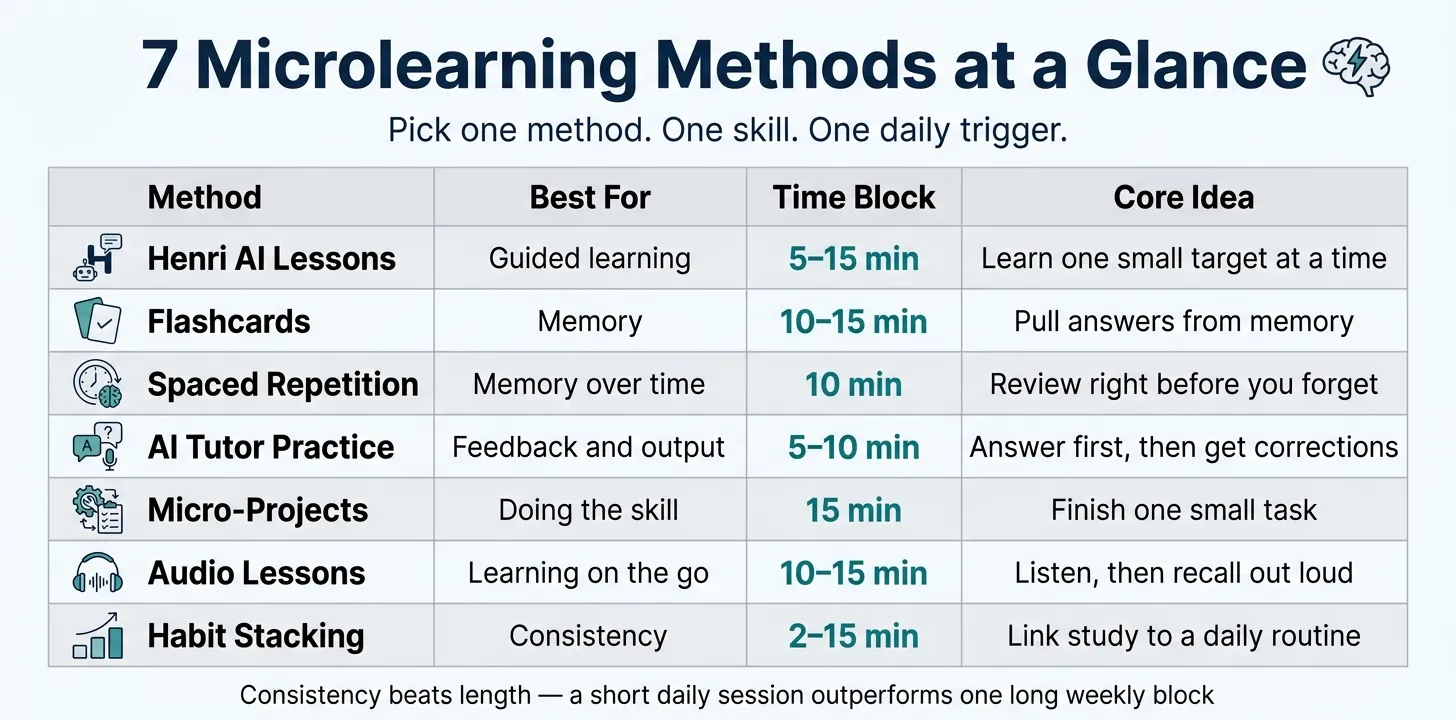
| Method | Best for | Time block | Main idea |
|---|---|---|---|
| Henri AI lessons | Guided learning | 5–15 min | Learn one small target at a time |
| Flashcards | Memory | 10–15 min | Pull answers from memory |
| Spaced repetition | Memory over time | 10 min | Review right before you forget |
| AI tutor practice | Feedback and output | 5–10 min | Answer first, then get corrections |
| Micro-projects | Doing the skill | 15 min | Finish one small task |
| Audio lessons | Learning on the go | 10–15 min | Listen, then recall out loud |
| Habit stacking | Consistency | 2–15 min | Link study to a daily routine |
If you want the short version, here it is: pick one method, one skill, and one daily trigger, then repeat it every day. That is the whole system in plain English.
Why Short Daily Sessions Work Better Than Long Study Blocks
Cramming can feel productive. The problem is that passive rereading often gives you a false sense of mastery. You look at the material and think, “Yep, I know this.” But without reinforcement, most new information fades fast. Short daily sessions work in a different way: when you review material before it slips away, your brain has to rebuild the memory instead of just spotting something familiar. That act of retrieval helps the memory stick.
There’s also a simple practical edge here. A 10-minute session is easy to start. A big weekly study block? That’s easy to push off until later. And later often turns into not at all.
Short, regular retrieval sessions spread across days and weeks tend to beat marathon review sessions on delayed tests. That matters because delayed tests show what you actually know, not what only looks familiar in the moment.
Different skills call for different study methods. If you want better results, match the method to the skill you’re trying to build:
| Skill Goal | Best Approach |
|---|---|
| Memory (vocabulary, formulas) | Spaced repetition, flashcards |
| Practice (coding, writing) | Micro-projects, interleaved practice |
| Error feedback | AI tutors, teach-back methods |
| Creation | Free recall, blank-page exercises |
Use the seven methods below to turn 5, 10, or 15 minutes into real progress.
1. Henri AI Bite-Size Lessons

For learners who want structure without having to map out every study session, Henri AI makes microlearning feel simple and steady. Its conversational lessons can fit into a small block when you choose one specific target for the session.
A useful session can follow a simple loop: focus on one target, work through an explanation, answer without copying, and use the feedback to decide what to practise next.
Henri AI builds a custom learning plan based on your topic and starting level. It supports languages, coding, writing, public speaking, and other practical skills. So if you want to move from Spanish vocabulary to Python basics, you can do that without starting from scratch.
You just tell Henri AI what you want to learn and where you’re starting. It then builds a lesson-by-lesson plan and moves you straight into the first lesson. The best approach is to choose one specific target for each session, like understanding Python list comprehensions instead of trying to learn Python all at once. Small targets make short sessions feel finished, not cut short.
2. Flashcards for Active Recall
Flashcards turn retrieval practice into a small daily routine. And that matters because flashcards make you pull information out of memory instead of just spotting it on a page. That kind of recall tends to stick better than rereading, since retrieval strengthens memory.
A good deck should fit into 10 to 15 minutes a day. Once the deck is in place, spaced repetition pushes back cards you already know. So your main job is simple: finish due reviews before adding new cards. If you skip that habit, overdue cards can stack up fast.
Flashcards work well for:
- Vocabulary
- Formulas
- Coding concepts
- Interview prep
For interview prep, use a question or short heading as the front of the card. Then try to recall your full answer from memory, not just think, “Yeah, I know that.”
One small tip can change how well this works: wait 20 to 30 seconds before revealing the answer. That awkward pause is the whole point. It’s the mental strain that helps the memory hold. Flip too fast, and active recall slips back into plain recognition.
For automatic scheduling, use spaced repetition tools.
3. Spaced Repetition with Anki
If flashcards help you remember, spaced repetition handles the timing. Tools like Anki schedule each review so you see a card right before you’re likely to forget it. That’s the sweet spot.
As the gaps get longer - 1 day, then 3, then 7 - recall gets a little harder in a good way. That extra effort helps the memory stay put.
Retrieval practice beats rereading, so even short review sessions can add up over time.
A simple way to use this method:
- Limit new cards to 10 to 20 per day
- Clear due reviews first
- Rate cards honestly
This works best for facts and definitions: vocabulary, syntax, formulas, and key speaking points. Use it for facts and definitions, then lean on the next methods when you need live practice or a finished deliverable.
4. Conversational AI Tutor Practice
Spaced repetition helps you remember. Conversational tutoring helps you perform.
A conversational AI tutor is useful when you need to practice what you already know. The point is active output: you answer first, then you revise based on feedback.
The big trap here is the illusion of competence - that feeling that you get it just because the AI explained it smoothly, even though you still can’t produce the answer on your own. So flip the flow. Explain the idea first, then ask the AI to point out what’s missing. Keep it simple and use one prompt for one skill. For example, ask the AI to critique a paragraph, predict where code will fail, or role-play an interviewer.
This one-prompt, one-answer, one-correction setup fits into 5 to 10 minutes. Each session should aim at one small target: write three sentences in a new language, solve one edge case, or explain one concept out loud.
Type or say your answer before the AI does. Don’t let it go first. That extra effort of coming up with the answer yourself is what helps it stick.
Use this method when you need live feedback. If you need a finished artifact, switch to a micro-project.
5. Micro-Projects You Can Finish in 15 Minutes
When feedback helps but you still need proof of skill, switch to a micro-project.
A micro-project turns 15 minutes into something finished. Keep the scope tight: one deliverable, one paragraph, one bug fix, or one short speech. That limit isn’t a flaw. It’s the whole point.
Making something forces you to retrieve what you know, and the result exposes gaps that a smooth explanation can hide. The value of a micro-project is not speed for its own sake; it is a small piece of evidence that you can use the skill.
The key is keeping the task small enough that you can finish it in one sitting. For writing, draft one paragraph from memory. For coding, build one small unit, like a password generator or countdown timer. For speaking, explain one concept out loud in plain language.
Here’s a simple trick that works well: stop mid-task on purpose and leave yourself a quick note about what to do next. That makes it easier to restart the next session and cuts down on friction.
6. Audio Lessons During Commutes or Chores
Your commute, walk, dishes, or laundry can turn into learning time without adding a single thing to your calendar. That’s the upside of audio.
But there’s a catch: just listening isn’t enough.
Passive listening is easy to confuse with learning because the material feels familiar while it is playing. Without a recall step, it is difficult to tell what you can actually use later.
A simple fix is a listen-and-recall routine. Listen for 10 minutes, then use the last 5 minutes to explain the idea out loud in your own words. That shift matters. You’re not just hearing the idea anymore - you’re trying to pull it back from memory. And if you get stuck, that’s useful. It shows you exactly where the gap is.
Audio is a good fit for:
- languages
- facts
- simple concepts
It’s not a good fit for diagram-heavy topics or hands-on skills, where you need to see steps or practice as you go.
That same pattern gets even stronger when you tie learning to a fixed daily routine.
7. Habit Stacking: Pair Learning with a Daily Routine
One of the easiest ways to make learning last is to stop treating it like a separate chore. Instead, tie it to something you already do every day on autopilot - your morning coffee, lunch break, or the last few minutes before bed. That’s what habit stacking does: it turns learning into part of the flow of your day.
The formula is simple: “Immediately after [existing habit], I will [learning action] for 5–15 minutes.” That cue cuts out the usual back-and-forth of deciding when to study. Your current habit handles the timing for you.
The key is to match the cue to the kind of learning you’re doing. Coffee works well for drills. Lunch fits light review. Bedtime is a good spot for recall.
| Trigger Habit | Best Use Case | Recommended Method |
|---|---|---|
| Morning coffee | Language, coding | Spaced repetition flashcards |
| Start of workday | Technical/coding | Interleaved practice, coding drills |
| Lunch break | General knowledge | Micro-learning (1 page or 1 short video) |
| Evening/bedtime | Writing, reflection | Free recall or quick recall write-down |
If an evening review fits your routine, use it for recall rather than starting a large new task.
Once the cue is set, the main choice left is session length. And here’s the big idea: consistency beats length. A short daily session does more for you than an occasional long study block.
Busy day? Use a 2-minute fallback: one flashcard set, one quick recall drill, or one short audio recap. Keep the cue the same, then scale that routine into a 5-, 10-, or 15-minute daily plan.
How to Build a 5-, 10-, or 15-Minute Daily Learning Plan
Pick a time block that fits the day you already have, then do the same thing again tomorrow. That simple rhythm matters more than squeezing in one big study session now and then. Retrieval and repeated practice make a short block more useful than passive exposure. Instead of aiming big, aim repeatable.
Use the chart below to choose the smallest block that fits your routine.
| Time Block | Method | Best Use Case | Skill Type | Example |
|---|---|---|---|---|
| 5 min | Free Recall / Brain Dump | Right after a lesson or meeting | Remembering facts | Write 3 things from memory |
| 5 min | Audio Lessons | Morning commute or doing dishes | Listening and understanding | Listen to one short segment, then recap it from memory |
| 10 min | Spaced Repetition Review | Coffee break or habit-stacked with lunch | Memorization | Review 15–20 flashcards on vocabulary, formulas, or key concepts |
| 10 min | AI Tutor Practice | When you need to clarify a concept fast | Thinking through problems | Ask Henri AI to quiz you before giving hints |
| 15 min | Henri AI Bite-Size Lessons | Morning routine or start of workday | Learning a new skill | Work through one small concept - a grammar rule, a coding pattern, or a writing technique |
| 15 min | Micro-Projects | Lunch break or weekend | Building or fixing things | Build one small, functional thing: a single API endpoint, a paragraph draft, or a short script |
After you choose a block, tie it to a set trigger. For example:
- right after your morning coffee
- after lunch
- at the end of a meeting
- before you open social media
This is where a lot of plans fall apart. People often start with the version that looks best on paper, not the one they can do on a busy Tuesday. A 5-minute block you repeat beats a 15-minute plan you skip.
Start with the smallest block you can do tomorrow. When that starts to feel automatic, add a second block. Keep it light. Keep it easy to start. That’s usually what makes the plan stick.
Conclusion
You don’t need long study sessions to build a skill. Short, repeatable sessions add up fast when they center on retrieval and practice.
Pick one method, one skill, and one daily trigger. Whether you use flashcards, an AI tutor, or a micro-project, the win comes from doing it again and again.
Start with one small block today, then do it again tomorrow. Tie one method to one daily trigger, and keep it small enough that you’ll stick with it.
Frequently asked questions
Which learning method should I start with?
Start with one method that matches the skill and the time you already have. Use flashcards for facts, an AI tutor for feedback, or a micro-project for practice. Add another method only after the first feels repeatable.
How long before I notice progress?
Progress depends on the skill and the quality of practice. Look for small evidence each week: an answer you can recall, a mistake you can now correct, or a small task you can finish without a guide.
What should I do if I miss a day?
Resume with the next small session instead of cramming. If reviews have accumulated, clear a manageable number of due items and temporarily reduce new material.