
Henri Blog
How AI Tutors Personalize Learning Pace
Personalized AI pacing matches lessons to your forgetting curve, schedule, and real-time signals.
By Henri · Updated
Related videoWhat Is AI Tutoring? A Guide to AI Tutoring in 2026Watch on YouTubeAI tutors work best when they change pace as you learn, not when they follow a fixed plan. I’d sum it up like this: they watch your quiz results, answer speed, hesitation, and study pattern, then adjust lesson speed, review timing, and task difficulty on the fly. Here’s the short version:
- I move ahead faster when I’m getting answers right with little delay
- I get more review when I miss key ideas or come back after a break
- I stay at the same level when I’m correct but still slow or unsure
- I get shorter, better-timed sessions when my schedule is packed That matters because more time doesn’t always mean more learning. In one trial of about 50,700 adult learners, machine-learning study plans helped people keep material for 69% longer and come back within a week 50% more often. Other findings showed AI-based review timing can cut daily review load by 20% to 30% while keeping recall steady. What stands out to me is simple: <u>good pacing is not just about going faster or slower</u>. It’s about matching the next step to what I know, what I’m close to forgetting, and how much time I have today. That’s the idea behind tools like Henri AI, which use conversation, quizzes, and reminders to keep learning moving without overload.
What Is AI Tutoring? A Guide To AI Tutoring In 2026
Step 1: Read the Signals That Tell the AI When to Speed Up or Slow Down
AI tutors watch for signals that show when to move faster, slow down, or go back and review.
Quiz results and error patterns
Some tutors track mastery as a probability and only move on when confidence is high. That estimate shapes both the next question and the pace of the lesson. If you keep missing the same sub-skill, the tutor shifts into more practice instead of pushing ahead.[2]
Response time and hesitation
Your response speed tells the AI something your score by itself can’t. A fast, correct answer points to fluency. A slower answer, even when it’s right, can hint at uncertainty. That extra clue helps the tutor decide whether to keep going or ease up. A slow correct answer can be a sign that the tutor should add one more example before moving on.[2]
Study streaks, session length, and consistency
Consistency helps the tutor model your forgetting rate with more accuracy. Research shows that individual forgetting rates are stable within a person but vary a lot from one person to the next.[2] When your study pattern stays steady, the tutor can time reviews around your forgetting curve with better precision. Miss a few days, and the tutor may shorten the next lesson and bring review items forward. Keep a steady streak, and it can add more new material without pushing too far, too soon. These signals tell the tutor not just when to move, but also how fast and how hard the next step should be. Once it has those signals, it can adjust lesson speed and task difficulty from one step to the next.
Step 2: How AI Tutors Adjust Lesson Speed and Task Difficulty
Those signals usually lead to one of two things: the tutor slows down or it moves faster. In practice, that shows up in three visible changes: pace, difficulty, and scaffolding.
When the tutor slows down
If your performance starts to slip, the tutor shifts gears. It may shorten explanations, add hints, or split the task into smaller steps so the work feels less like hitting a wall and more like moving one piece at a time.
When the tutor speeds up
If mastery tracking shows you’re fluent on a topic over time, the tutor cuts back on review and moves forward. That means it can skip material you’ve clearly retained and bring in more advanced content sooner.
How difficulty changes from one task to the next
Here’s how those signals can shape the next task.
| Learner signal pattern | Difficulty change | Example task type |
|---|---|---|
| Consistent incorrect answers on a specific concept | Decrease: slow down and provide prerequisite refreshers | Foundational multiple-choice or concept review |
| Fast, correct answers over multiple sessions | Increase: speed up and skip redundant reviews | Multi-step application task or advanced concept introduction |
| Correct answer with significant hesitation | Maintain: keep the level steady, but add hints or visual diagrams | Guided practice with a hint |
| Mixed right-and-wrong answers | Adjust: break the task into smaller practice steps | Scaffolded task with step-by-step prompts |
Step 3: How AI Tutors Time Your Reviews With Spaced Repetition
Fixed vs. AI-Personalized Learning: Retention & Review Stats
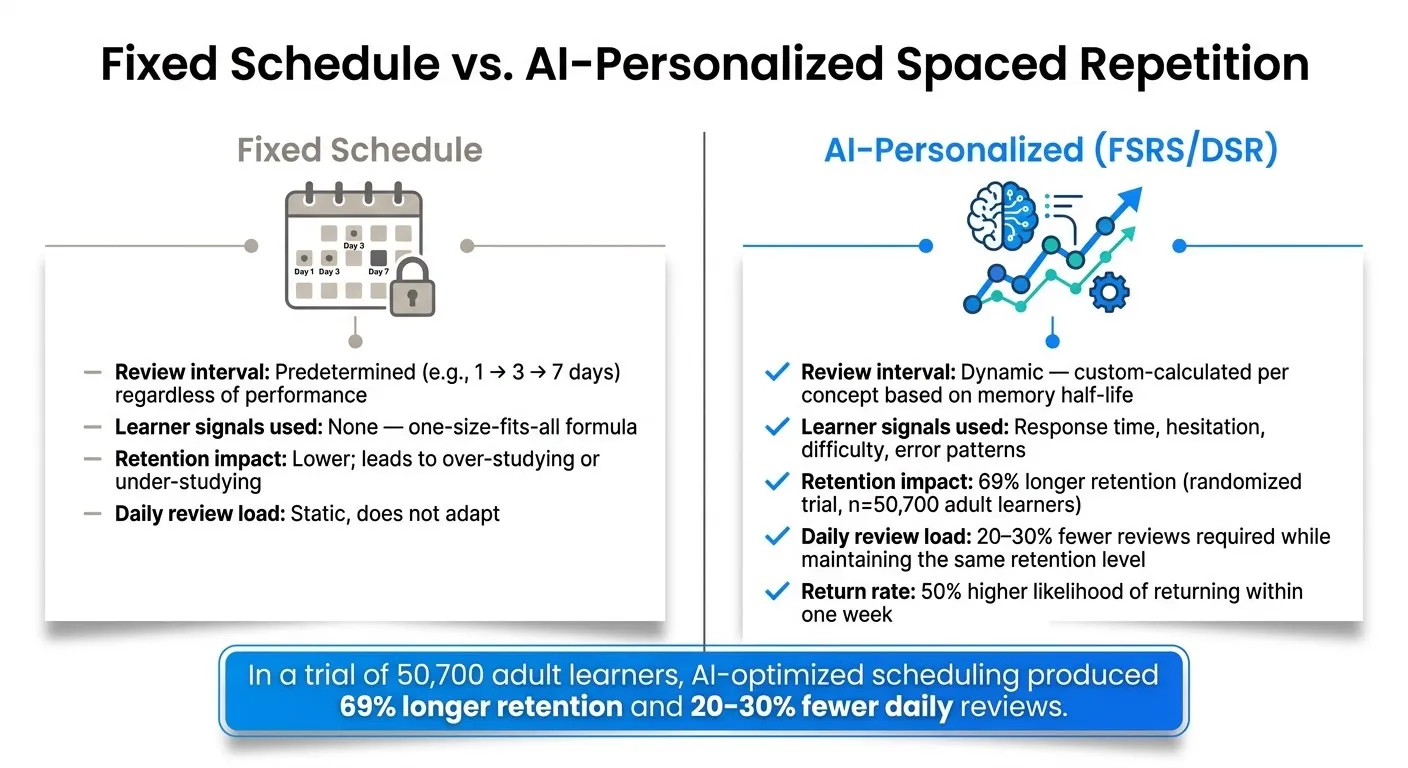
The other half is deciding when a topic should come back. That pacing control shapes review timing, and it’s the third pacing lever alongside lesson speed and task difficulty.
How review intervals change after strong or weak recall
Each answer updates the app’s estimate of what you still know based on three factors: how hard the topic is, how well it sticks, and how likely you are to recall it now. Together, those factors determine when the next review shows up. [2][3] That timing changes with your performance. A fast, correct answer pushes the next review farther out. If you hesitate, the review stays closer. If you miss it, the system brings it back soon. The idea is simple: schedule the next review right before recall is likely to drop below the target, such as 90%. That way, the memory gets reinforced before it fades. [2][3] In a randomized trial with 50,700 adult learners, the machine-learning-optimized group retained content 69% longer than learners using standard spacing rules. [2]
How daily review volume adapts to real-life schedules
A fixed schedule can’t react to a deadline, a packed day, or a free afternoon. An AI-based system can. It tracks your session length, consistency, and how many reviews are due each day, then adjusts the workload. On busy days, it surfaces only the highest-priority reviews, meaning the items closest to being forgotten. If you’re on a strong study streak, it can add more reviews. Research shows that AI-optimized scheduling can cut the number of daily reviews by 20% to 30% while keeping retention at the same level. [2][3] That makes staying on track a lot easier when life gets hectic.
Fixed review schedules versus AI-personalized timing
| Approach | Review interval pattern | Use of learner signals | Impact on retention |
|---|---|---|---|
| Fixed schedule | Predetermined (e.g., 1, 3, 7 days) regardless of performance [4] | None; follows a one-size-fits-all formula [2] | Lower; often leads to over-studying or under-studying [2] |
| FSRS / DSR (modern AI) | Dynamic; custom-calculated for every concept based on memory half-life [3] | High; uses response time, hesitation, difficulty, and error patterns [2][3] | 69% longer retention and 20% to 30% fewer required reviews [2] |
In Henri AI, this shows up as reminders and quizzes that fit short study windows without making review feel rigid.
Step 4: Use Henri AI to Build a Pace That Fits Your Life
How Henri AI uses conversation, quizzes, and reminders to support pacing
Henri AI builds a custom syllabus for any topic and teaches through conversation, which lets it shift the pace as you learn.[1] Inside Henri, those signals affect three core controls: lesson speed, task difficulty, and review timing. Henri looks at quiz accuracy, response speed, and hesitation to decide what to do next. It may move ahead, slow down, or add a visual aid before the next step.[1] Your answers shape the next lesson, and your consistency shapes when reviews show up.[1]
How to keep a steady pace in short study windows
Henri fits into short windows of time - a morning train ride, a coffee break, or a few minutes before bed.[1] A couple of simple habits tend to work well with the way Henri is built:
- Don’t skip the quizzes. They’re the main signal Henri uses to decide whether to move faster or slow down.[1]
- Use review cards during very short windows. If you only have 1–2 minutes, going over a card from an earlier lesson still strengthens memory and helps you keep moving.[1]
What personalized pacing looks like inside Henri AI
You can see these patterns pretty clearly in day-to-day use.
| Learner behavior in Henri | AI interpretation | Pacing change | Illustrative microlearning scenario |
|---|---|---|---|
| Consistently correct quiz answers | High mastery / high stability | Accelerates to next syllabus chapter | After a user aces a quiz on “Stoic Ethics”, Henri skips the basic summary and introduces “Applying Stoicism to Modern Stress.” |
| Repeated errors or hesitation | High difficulty / low retrievability | Slows down and provides visual aids | A learner struggles with “Opportunity Cost”; Henri pauses the text lesson to generate a concept map and asks a simpler clarifying question. |
| Consistent daily 10-minute sessions | High engagement / steady learning rate | Maintains optimal spacing; avoids overload | A before-bed session where Henri provides a quick summary of the day’s wins. |
| Returning after a 3-day break | Memory decay (forgetting curve) | Prioritizes review of old review cards before new content | Before starting a new lesson on “AI Neural Networks”, Henri prompts a 2-minute review of “Machine Learning Basics” covered three days prior. |
That’s the practical difference here: the pace keeps shifting based on how you respond. In day-to-day use, Henri keeps adjusting until the next lesson or review feels like a good fit.
Conclusion: The Best Learning Pace Is the One That Keeps You Moving
AI-personalized pacing helps you keep going without feeling buried. A fixed study plan follows a set timeline. This kind of pacing does something else: it responds to how you’re doing in the moment, not to a preset calendar. You can spot that balance in a few clear ways.
Key signs of good pacing personalization in an AI tutor
A good AI tutor keeps you in the sweet spot: pushed enough to make progress, but not so much that you stall out.
| Sign of good pacing | What it means for you |
|---|---|
| Targeted review, not blanket review | Concepts with low recall probability get scheduled for review instead of everything you’ve ever studied. |
| Difficulty that shifts with mastery | New tasks get harder as you show understanding and easier when you need more support. |
| Realistic daily workload | Daily workload stays realistic without sacrificing retention. |
In Henri AI, you can see that balance in lessons, quizzes, and reminders that change based on your responses. That’s what personalized pacing is trying to solve: a learning pace that matches your forgetting curve, your schedule, and your current level of understanding - and keeps adjusting as those change.
Frequently asked questions
How does the AI know when I’m ready to move on?
AI tutors track how you perform and how engaged you are to estimate how well you know a topic. They look at signals like quiz scores, how many tries you need, and how long you take to answer. Once your mastery hits a set threshold, the system moves you to new material at a challenge level that fits where you are. Keeping lessons in small chunks makes learning easier to handle without making it any less demanding.
What happens if I study irregularly or take a break?
Studying off and on - or taking a break - doesn’t mean you have to start over. Henri keeps track of your personal knowledge state, so when you come back, you can pick up right where you left off. Memory fades with time. That’s just how learning works. To help you stay on track, the app sends daily reminders that support a steady study habit. And when you return, it keeps shaping the experience around your goals.
Can personalized pacing help me learn more in less time?
Yes. Personalized pacing can help you learn more efficiently because it puts your time where it matters most instead of forcing you through a fixed, one-size-fits-all curriculum. AI can use signals like quiz results, response time, and engagement patterns to adjust task difficulty and review timing. In plain English, that means you spend less time on material you already know and more time on the parts that still need work. That can help in a few ways: - You revisit material before you forget it - You avoid cognitive overload - You build a steadier learning habit The big idea is simple: the pace shifts with you, not the other way around.