
Henri Blog
Henri Integrates DeepSeek V4 for Custom Courses
Henri now runs on DeepSeek V4's 1M-token context and thinking mode, giving custom AI courses better memory and sharper questions. See how it works.
By Henri · Updated
What is DeepSeek V4?
DeepSeek V4 is DeepSeek’s fourth-generation language-model family. A preview shipped on 24 April 2026. The flagship, V4-Pro, moved to an official build (0813) around 13 August 2026. There are two tiers:
deepseek-v4-pro: the flagship reasoning modeldeepseek-v4-flash: faster and cheaper, built for high-volume, low-latency use Both tiers share two things that matter for a learning product: a one-million-token context window and a thinking mode. The 1M window means the model can hold an enormous amount of prior conversation, source material, and structure in view at once, instead of forgetting everything outside a short rolling window. Thinking mode means the model can reason through a problem internally before producing an answer, rather than pattern-matching straight to a response. Official names, API IDs, and benchmark claims live in DeepSeek’s own release notes. People comparing labs will keep publishing leaderboards, and those numbers move week to week; we’re not reprinting them here. What’s stable enough to write down is the architecture: two tiers, one context length, a reasoning mode. That’s what the rest of this article is about.
How DeepSeek V4 enhances Henri
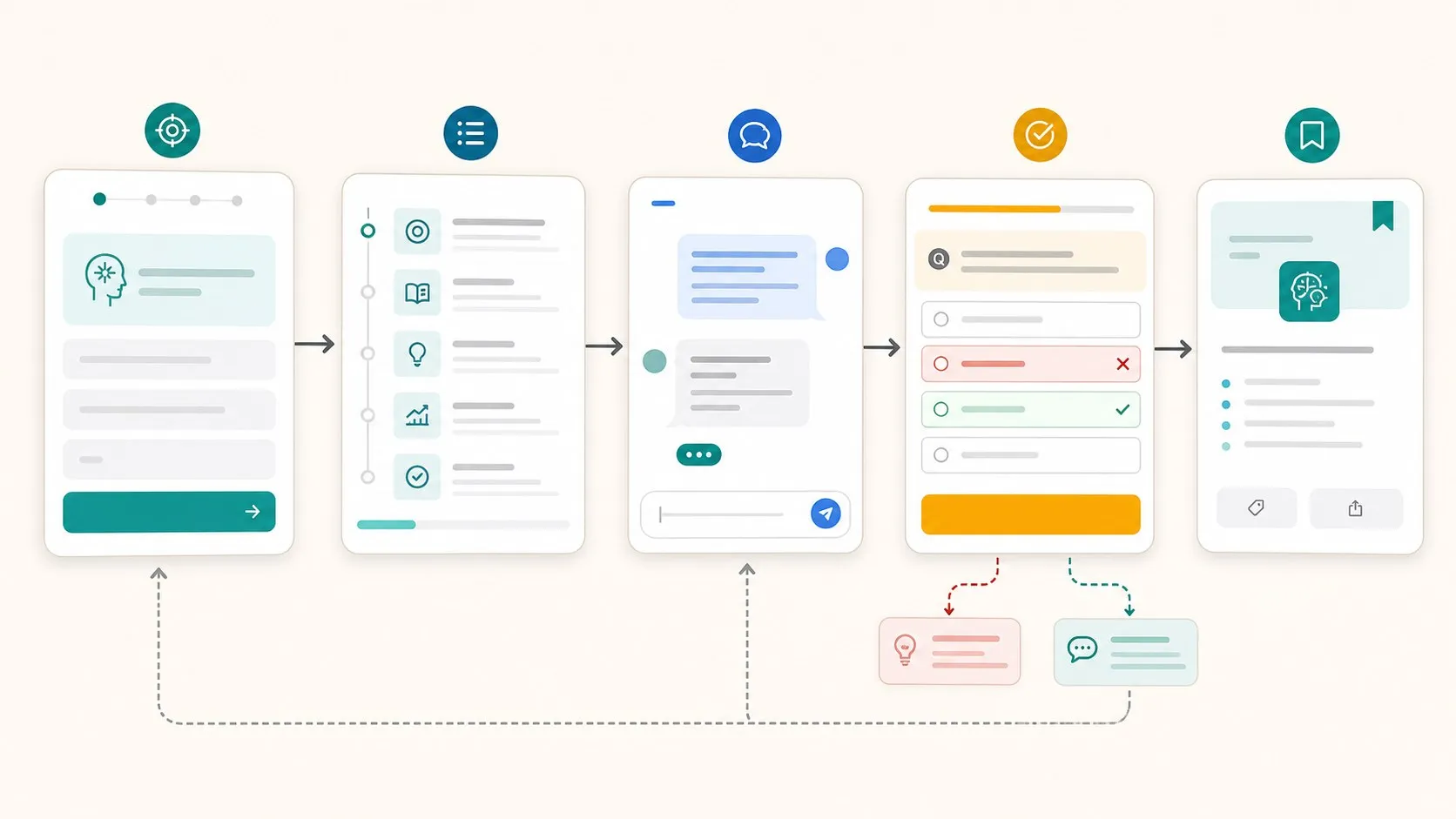
A stronger model on its own doesn’t make anyone learn faster. It makes anyone sound more informed faster, which is a different thing. Where DeepSeek V4 actually changes what Henri can do is in two specific places: memory and questioning. The 1M context turns a course into one continuous object. Before a 1M window, a tutor sees a page, then another page, and forgets the first unless something is built to retrieve it back. A course isn’t a page; it’s a sequence: what you already claimed to know, where the syllabus put you, the quiz you missed last week, the card you flagged as shaky. A million tokens means Henri can keep that whole object in view at once: the syllabus, your last several answers, yesterday’s diagram, the goal you typed on day one. The model isn’t reconstructing who you are from a six-message stub every time you open the app. Thinking mode turns “reasoning” into a better question, not a longer answer. In a chat window, thinking mode usually means “show me the chain of thought” before the final answer. In a tutor, that’s the wrong output. Henri uses thinking mode to do the reasoning before the next question: working out what you actually seem to understand, what you’re likely faking, and which single question you can’t answer without genuinely knowing the material, then branching based on whether you get it right. That’s the difference between a model that reasons out loud and one that teaches. Neither of these is new behavior for Henri. The lesson loop (explain, check, branch on the wrong answer) already existed. DeepSeek V4 gives that loop more working memory and sharper questions. It doesn’t replace the loop, and it doesn’t do the job on its own: dumping a textbook into DeepSeek V4 and asking for a summary is still just a dump. Something still has to be in charge of the path: first the plan, then the conversation, then the check.
What is Henri?
Henri is an AI-powered microlearning app that turns any topic into a structured course instead of a chat transcript. You pick a topic, Henri writes a syllabus, and then it teaches through a back-and-forth conversation, not a lecture you skim, ending each lesson with a quiz and a knowledge card you actually keep. The model underneath is doing the answering and asking; the syllabus, the questioning method, and the recall check are Henri.
What a lesson looks like now
You still start with a topic: cognitive psychology, stoicism, how a solar eclipse works, whatever you’ve been bluffing about. Henri asks what you already know and how much time you have, then writes a syllabus you can reject or keep. The syllabus is the contract: four chapters, eighteen lessons, a sentence for each beat. If chapter one is wrong for you, you say so before you sit through it. DeepSeek V4 makes that plan more coherent because it can see the whole arc while it’s writing chapter two. Then the lesson itself is a conversation, not a lecture you half-watch. In the forgetting-curve lesson, for example, you get the idea, then a chart, then a question about when to review, and the model holds the chart and your last answer at the same time. That’s the 1M window doing product work, not demo work. At the end: a quiz, then a knowledge card. The card is the thing you actually keep. If the card is vague, the lesson failed, no matter how sharp the model sounded getting there.
V4-Pro and V4-Flash inside Henri
Both tiers share the 1M context. The split is speed and difficulty, not “real V4” versus a toy.
| V4-Pro | V4-Flash | |
|---|---|---|
| Official role | Flagship reasoning | Faster, cheaper |
| Context | 1M tokens | 1M tokens |
| In Henri | The chapter you still can’t explain | Short lessons, first pass through a syllabus |
Use Flash when you’re moving fast through material. Use Pro when you’ve been nodding along and can’t produce the sentence. For interfaces and IDs, see DeepSeek’s own announcement; we’re not laundering a third-party benchmark into a marketing table.
Why this belongs in a tutor, not a chat window
Open the DeepSeek site directly and you still get an answer: faster, longer, better-reasoned. None of that is the same as knowing the idea. Learning has a rude test: close the phone, say the thing in your own words. If you can’t, you collected text. A stronger model makes that failure mode more pleasant, which is worse, not better. A good check: after one sitting, you should be able to explain the shape of the idea to someone who wasn’t in the lesson. If you can only recap the model’s wording, stay on that chapter. DeepSeek V4 won’t save a lesson you refused to fail in public, even if “public” is just you, talking at your phone. We’re also not claiming Henri is DeepSeek. DeepSeek is the lab and the model. Henri is the syllabus, the quiz, the card, the reminder to come back tomorrow. Swapping the engine underneath doesn’t retire that work.
What did not change
Henri is still a custom course, not a feed of other people’s videos. It still teaches through questions. It still ends on recall. DeepSeek V4 doesn’t add new subjects; you could already ask for quantum mechanics or negotiation tactics. The catalog was never the bottleneck. The bottleneck was always whether the tutor could hold the course and still push back.
Mistakes this news will produce
Pasting the PDF and calling it a course. V4 will summarize the PDF. You’ll feel informed. Next week the idea will be gone. If you want a course, start in Henri and let the PDF wait. Chasing every V4 benchmark chart on social media. Official IDs and the 1M window are stable enough to write down. Screenshot leaderboards aren’t. Treating thinking mode as a lecture. If the model thinks for thirty seconds and hands you the answer, you were entertained. In Henri, the thinking should happen before the next question, not instead of it. Waiting for a perfect model before studying. This is a good week to start a topic you’ve been postponing. It’s a bad week to wait for V5.
How to start today
- Open Henri.
- Pick a topic you keep pretending you understand. One sentence for the goal is enough.
- Read the syllabus. Cut a chapter if it’s there for decoration.
- Do one lesson. Speak the checkpoint out loud. If you can’t, stay on that lesson.
- Leave with the knowledge card, not a saved chat.
If you want a course that already exists as a public intro, start with AI Literacy or the Explore library. The DeepSeek V4 engine sits under those the same way it sits under a topic you invent yourself.
Frequently asked questions
Does Henri use DeepSeek V4 now?
Yes. Henri integrates DeepSeek V4 as the model powering custom courses. The syllabus, the conversation, the quiz, and the knowledge card are still Henri. The engine answering and asking is DeepSeek V4.
What is the difference between DeepSeek V4-Pro and V4-Flash for learning?
Both have a 1M-token context. Flash is the daily lesson. Pro is the chapter that won't click. You don't need Pro to start; you need it when Flash's questions get too easy or too generic for the specific mistake you're making.
Is DeepSeek V4 better than ChatGPT for studying?
For a paste-and-answer workflow, that comparison is a price-and-taste fight that will look different next month. What does matter for studying specifically is context memory: a 1M-token window means a tutor built on DeepSeek V4 can hold your whole course (syllabus, past answers, flagged cards) in view at once, rather than losing the thread after a few exchanges. Henri's bet is that a syllabus plus a question plus a card beats a stronger dump of prose, and DeepSeek V4 makes that bet cheaper to run and easier to hold in memory. It doesn't replace the bet.
Will Henri keep my whole course in one window?
That's what the 1M context is for: the plan, the recent answers, the cards, the goal. It's not a promise that you never have to review; review is the point. The window means the tutor isn't amnesiac between lessons.
Do I need to know the API IDs?
No. `deepseek-v4-pro` and `deepseek-v4-flash` are what developers type. In Henri, you pick a topic, not a model string. The IDs are here so the news and the product are talking about the same release.