
Henri Blog
How Conversational Learning Helps You Learn Faster
Use short, active study conversations—recall, explain, and get instant feedback to retain more in less time.
By Henri · Updated
If I want to learn faster, I need to stop only rereading and start answering questions from memory. That is the core idea. The article shows that conversational study helps because it makes me recall, explain, and fix mistakes right away. One study in the article says students who tested themselves remembered about 80% after one week, compared with about 35% for students who only reread.
Here’s the short version:
- Passive study feels busy but often fails later
- Conversation forces recall, not just recognition
- Explaining in my own words helps ideas stay longer
- Fast feedback helps stop errors early
- Short 5- to 15-minute study talks can work better than one long review
- I can do this with an AI tutor, a study partner, or self-made prompts
- A microlearning app like Henri AI can make the habit easier to repeat
What I like about this approach is that it turns study into action. Instead of staring at notes, I ask, answer, explain, and check. That is where the learning happens.
The article also points to a simple routine I can use every day:
- Before studying: ask what parts of the topic are hardest
- During studying: mark what confuses me
- After studying: do a short brain dump from memory, then explain it out loud
Bottom line: conversational learning helps me learn more in less time because it makes my brain do the work, not just my eyes.
How conversational learning helps you learn faster
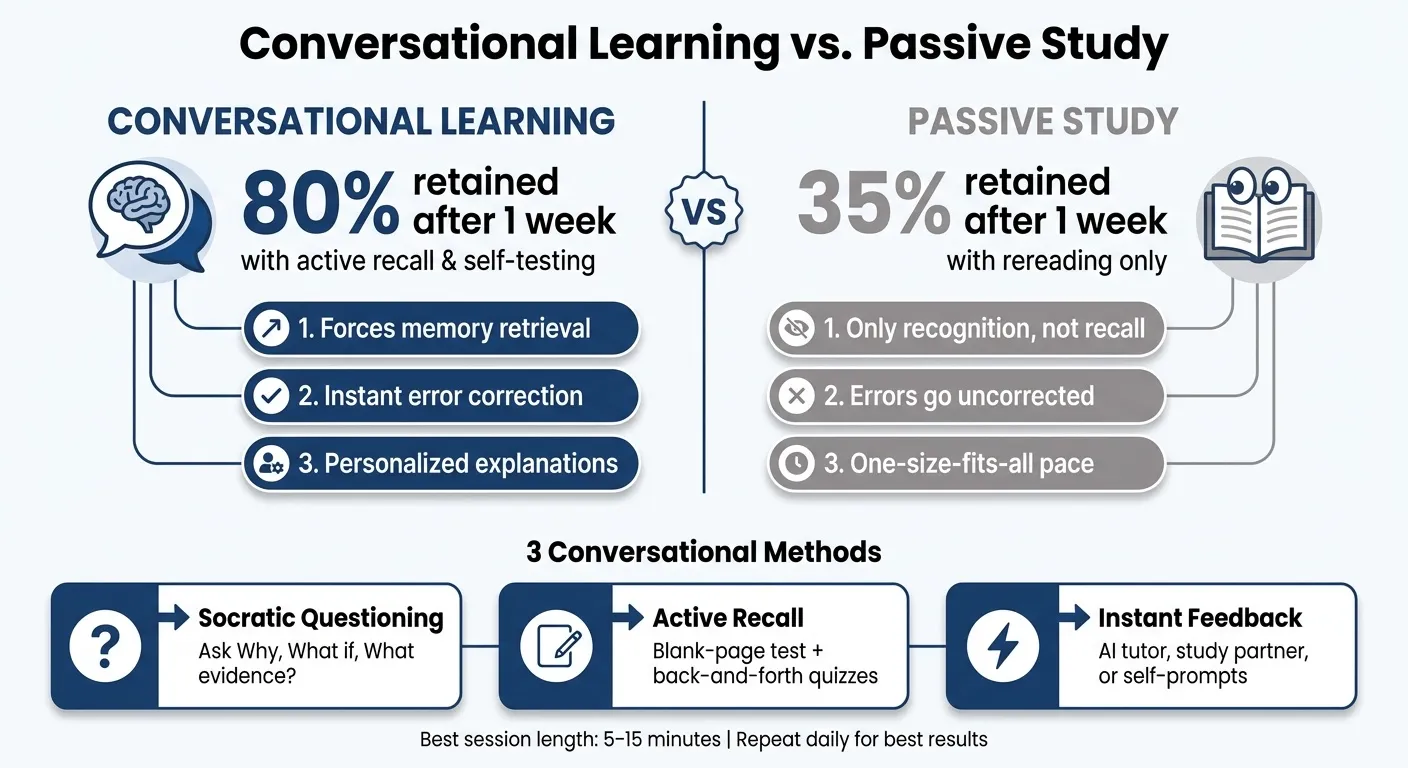
Conversational learning speeds up study because it pushes you to retrieve ideas, not just recognize them on a page. That small shift matters a lot. Instead of thinking, “Yeah, that looks familiar,” you have to pull the answer out of memory, and that extra effort helps it stick.
Answering and explaining makes ideas stick sooner
When you explain a concept in your own words, you’re doing something very different from just reading it. Psychologists call this the generation effect: ideas you produce yourself stick better than ideas you only read [1][2].
Testing yourself can feel harder for a reason. It interrupts that smooth, easy feeling you get from rereading. But that friction is often what helps learning sink in.
Instant feedback corrects mistakes before they harden
One of the biggest hidden costs of passive study is uncorrected errors. You can repeat the wrong idea without noticing it. A real-time response can stop that early by pointing out the mistake before it settles in. And when feedback zeroes in on the exact error, you can work on the gap that matters instead of rereading material you already know [3].
Personalized explanations cut through confusion
A textbook gives everyone the same explanation, in the same order, at the same pace. A conversation works differently. If something doesn’t click, you can ask for a simpler analogy, another example, or a slower walkthrough and get it right away.
That kind of tailored help meets you where you are. It turns “I don’t get it” into a clear next move.
These gains are strongest when you use structured conversational methods. That’s why study approaches like Socratic questioning and active recall work so well.
The most effective conversational study methods
These methods speed learning because they make you pull information from memory, explain it out loud, and fix mistakes on the spot. Once you know why conversation helps, the next move is picking the study format that fits the moment.
Socratic questioning to deepen understanding
Socratic questioning checks your reasoning, not just what you can repeat from memory. Ask things like: Why? What if? What evidence supports it? Each follow-up question pushes you to defend your thinking instead of reciting a definition [4].
This works especially well when facts need to link to a bigger idea. When you have to explain why something is true, you start connecting ideas instead of storing each one in its own little box. A simple prompt can help: “Act as my study partner on [topic]. Ask one open-ended question at a time and guide me to the answer.” Keep that exchange going for at least five back-and-forth turns. It’s a practical way to spot weak areas in your understanding [6].
Active recall through back-and-forth prompts
If Socratic questioning helps you find weak spots, active recall helps you fix them.
The simplest version is the blank-page test: after studying, close everything and write down all you can remember. Then check your notes and see what you missed [2]. With a study partner, this can turn into short quizzes where one person explains a concept from memory and the other checks it for accuracy. If you’re using an AI tutor, type out your current understanding - even if it’s messy - and ask: “I think [concept] works like this… Am I missing anything, or is my logic weak?” That keeps the mental work on your side, where it belongs.
3 ways to get instant feedback: AI tutor, study partner, and self-prompts
Use the format that fits your study setup.
| Feedback Method | How to Use It | Best For |
|---|---|---|
| AI tutor | Upload your notes, generate a short quiz, then ask for line-by-line feedback [6] | Solo study |
| Study partner | Have them ask follow-up questions and stop at the first point where your explanation breaks down [3] | Complex reasoning topics |
| Self-prompts | Write 3–4 questions that cover the core ideas after reading; answer them from memory the next day [2] | Quick self-review |
How to fit conversational learning into your daily routine
Use short study conversations instead of long passive sessions
Once you know the methods, the next step is making them fit into normal life. That’s where conversational learning shines. Instead of sitting through one long passive review session, you use short bursts of active thinking.
A good place to start is with 5- to 15-minute study blocks. Swap one long session for a few short conversational ones spread across the day. That could be a 10-minute break between tasks, part of your commute, or a quick review before bed. Short sessions are easier to repeat, and the spacing gives memory time to consolidate.
Apply conversational learning before, during, and after reading
Use this simple sequence to turn reading into a back-and-forth process instead of a one-way intake.
| Study Phase | What to Do | Why It Helps |
|---|---|---|
| Before | Ask an AI tutor: “What are the 3 hardest parts of [topic]?” | Focuses attention |
| During | Read or watch the lesson and note specific points of confusion | Shows what needs follow-up |
| After | Do a 5-minute brain-dump, then explain it to an AI or partner | Forces retrieval before you check any source |
The after step is where retrieval practice tends to do the most work. You’re not just looking things over again. You’re pulling them from memory, which makes weak spots much easier to spot.
How to tell if conversational learning is actually working
The clearest sign is simple: new but related material starts taking less time to understand. That usually means your grasp is getting stronger, not just your sense of familiarity.
A few signs to watch for:
- Better scores on practice quizzes
- Being able to explain a topic out loud without looking at notes
- Fewer repeated mistakes on the same concept
If a session feels too easy, there’s a chance you’re recognizing the material instead of recalling it. And if the same mistake keeps showing up, ask your AI tutor whether the issue is a recall, reasoning, or application problem [5].
A microlearning app can make this routine easier to repeat each day.
Henri AI: a conversational microlearning tool for everyday study
How Henri AI supports faster understanding and retention
If you want these study methods in one system you can use again and again, Henri AI turns them into short daily sessions. It starts with personalized onboarding that builds a study path around your weak spots. From there, the AI tutor changes its explanations based on what you haven’t learned yet.
If one explanation doesn’t land, it says it another way. If you get something wrong, it asks a follow-up question that helps surface the gap. Knowledge cards bring key ideas back at spaced intervals, which helps slow forgetting.
That matters because each session becomes easier to start, easier to finish, and easier to come back to the next day.
Why microlearning works for busy learners
Henri AI breaks study into chapter-by-chapter plans, so you’re not stuck wondering what to do next. You open the app, see the next step, and keep moving.
For busy learners, that kind of setup can make a big difference. Short sessions feel less heavy, and a clear path makes it simpler to stay consistent and keep learning active.
Conclusion: The fastest learning often looks like a conversation
Henri AI packages these methods into a format that fits normal schedules. In many cases, the fastest path to understanding looks less like a lecture and more like a good conversation.
Frequently asked questions
How is conversational learning different from rereading?
Conversational learning is active and based on retrieval. You come up with your own answers, get nudged on what you missed, and sharpen your thinking through back-and-forth dialogue. Rereading, on the other hand, is mostly passive. It can make the material feel familiar, but that feeling can be misleading. You’re seeing the ideas again, not pulling them from memory or testing whether you actually get them. Questions, Socratic-style prompts, and immediate feedback bring weak spots into the open and strengthen recall more than rereading by itself.
What if I study alone?
Studying alone doesn't have to feel like learning on an island. You can make solo study feel more like a back-and-forth by using AI as a study partner that pushes your thinking instead of doing the work for you. Here's the better move: start with your own answer first. Then ask the AI to pick it apart, spot weak points, or quiz you on what you think you know. That matters because active recall tends to stick better over time than simply rereading notes. So rather than asking for summaries or ready-made answers, use AI to pressure-test your reasoning and expose the gaps you still need to fix.
How do I know it’s working?
Conversational learning is doing its job when studying feels a bit harder, not when everything flows smoothly. That may sound backward, but easy back-and-forth can trick you. You start recognizing ideas and think, “Yep, I know this.” But recognition isn’t the same as learning. A few signs you’re on the right track: You’re producing more than you’re reading You notice the parts you can’t explain clearly You test your own recall instead of asking for the answer right away You push back on the AI, question its responses, or catch yourself getting lazy That kind of friction is often where the learning happens.