
Henri Blog
10 Bite-Size Study Habits for Busy Schedules
Short active-recall habits (2–15 minutes) tied to daily cues beat passive rereading and boost long-term retention.
By Henri · Updated
You do not need 1-hour study blocks to learn well. In many cases, 2 to 10 minutes of active review can work better than long cram sessions, especially since people can forget about 50% of new material within 1 hour and up to 70% within 24 hours.
Here’s the short version: I’d use small, repeatable study habits tied to moments that already happen in my day. The main pattern is simple: recall first, check second. That means I try to remember the idea before I look at notes. This article covers 10 ways to do that, including:
- 5-minute recall check-ins after a lesson
- Blank-page recall sprints
- Audio review during commutes or chores
- Flashcards with spaced repetition
- 2-minute AI question breaks
- End-of-day summaries
- 3-minute reviews tied to coffee, lunch, or bedtime
- One weekly micro goal
- Short audio playlists for review
- Weekend reset sessions
The core takeaway is clear: short review done often beats passive rereading done once in a while. Studies cited in the article also note that students using active recall remembered about 80% after one week, compared with 36% for passive review.
Quick Comparison
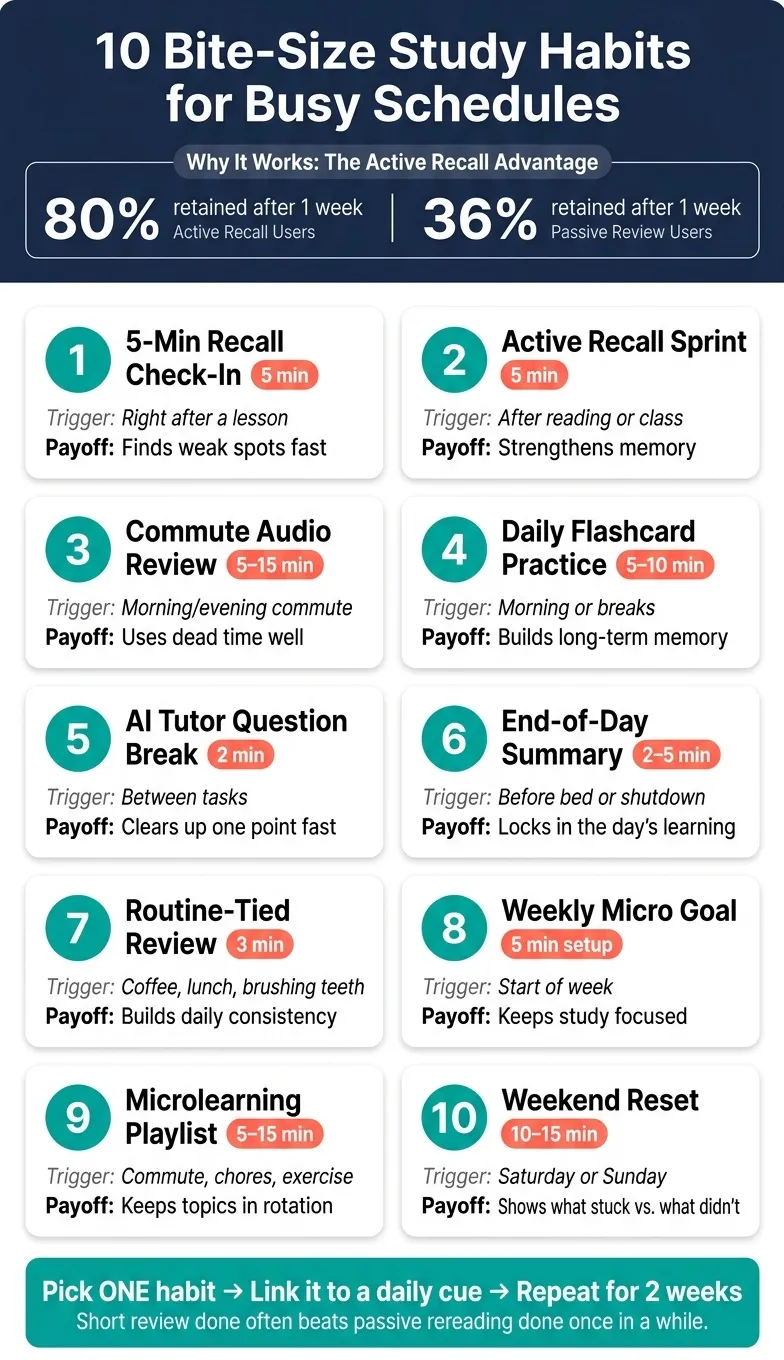
| Habit | Time | Best Use | Main Payoff |
|---|---|---|---|
| Recall check-ins | 5 min | Right after study | Finds weak spots fast |
| Recall sprints | 5 min | After reading or class | Strengthens memory |
| Audio review | 5–15 min | Commute or chores | Uses dead time well |
| Flashcards | 5–10 min | Morning or breaks | Helps long-term memory |
| AI question breaks | 2 min | Between tasks | Clears up one point fast |
| End-of-day summary | 2–5 min | Before bed or shutdown | Reviews the day’s key ideas |
| Routine-tied reviews | 3 min | Coffee, lunch, brushing teeth | Builds consistency |
| Weekly micro goal | 5 min setup | Start of week | Keeps study focused |
| Audio playlists | 5–15 min | Commute, chores, exercise | Keeps topics in rotation |
| Weekend reset | 10–15 min | Saturday or Sunday | Shows what stuck and what did not |
If I had to sum it up in one line, it would be this: <u>pick one small habit, link it to a daily cue, and keep it going for two weeks.</u>
Why Short Study Habits Work for Busy Schedules
The biggest thing that gets in the way of steady studying is the idea that it only counts if you sit down for a long session. For most busy people, that full hour just doesn’t show up. Short study sessions fix that. A 5-minute review at lunch, three flashcards in the pickup line, or a quick summary before bed uses time you already have. That’s what makes consistency possible. You don’t have to wait for the perfect study block.
Short retrieval sessions also work better than rereading because they make you pull the answer from memory instead of just looking at it again. That small shift matters. One retrieval practice session has been shown to beat three passive reviews for long-term retention [8]. The habits below use that idea in everyday moments.
It also helps to use if-then plans. Tie one daily cue to one study action. For example: “If I’m in the pickup line, I’ll do five flashcards.” This cuts out the choice of when to begin. Henri AI works well with this kind of plan because it makes short, focused review sessions simple to start.
1. Henri AI 5-Minute Recall Check-Ins

Time needed: 5 minutes | Best trigger: Right after finishing a lesson, chapter, or video
Right after a lesson ends, your memory is at its weakest. If you don’t review, you’ll forget about 50% of new information within one hour [1][4].
That’s where Henri AI fits in. It can turn your own notes, audio notes, or PDFs into quiz questions or flashcards [10][9][11]. So if you have a five-minute window right after studying, you can put it to work fast. Start with one or two questions, then stop once you hit five minutes.
Why does this help? Because active recall beats rereading. Instead of just seeing material again and thinking, yeah, I know this, you have to pull the answer from memory. That small shift matters a lot. Students who use active recall remember about 80% of material after one week, while students who reread remember only 36% [1][13].
Missed the right-after-study window? No problem. Do the same five-minute check-in at the end of your study block instead. You can use this same short review any time you finish a study block.
2. Five-Minute Active Recall Sprints
Time needed: 5 minutes | Best trigger: Right after reading, watching, or attending a lesson
If you want a tool-free option, try a five-minute recall sprint. It helps you get more out of short study blocks. The idea is simple: instead of reopening your notes and reading them again, close everything and rebuild what you just learned from memory. Rereading feels easy because it looks familiar. But it doesn’t make you pull the answer back up on your own.
The simplest version is the Blank Page Method. Take a blank sheet of paper or open a new document, set a five-minute timer, and write down everything you can remember about the topic. Don’t check your notes while you do it. When time’s up, go back to your notes and compare. The missing pieces show you what to review next [2][15].
One study found that students who restudied forgot 56% after two days, while students who used retrieval practice forgot only 13% [12].
If a fact won’t come to mind, give it 20–30 seconds before you check your notes [2][10]. That awkward pause is often where the learning starts to stick.
3. Commute-Time Audio Review
Time needed: 5–15 minutes | Best trigger: Morning or evening commute
If you already commute, turn that time into a built-in review block. It’s already set aside in your day, so use 5 to 15 minutes for a spoken recap instead of letting the ride slip by with passive listening.
At the end of a study session, record three or four main points from memory. Then play them back during your commute. Without review, you can lose about 70% of new information within 24 hours [1][6], and a same-day recap helps slow that drop.
The key part is this: don’t just replay the lecture. Say the idea out loud like you’re teaching it to someone else. That small shift matters. If you get stuck, ramble, or go blank, you’ve just found the part that needs more work. The point isn’t to pack your whole ride with audio. The point is to push fast recall.
If recording feels like a hassle, turn your notes or articles into audio and listen during the ride. Just keep it short enough that you can finish before you get where you’re going.
4. Daily Flashcard Practice With Anki or Quizlet
Time needed: 5–10 minutes | Best trigger: After breakfast or during your commute
If you want a study habit with almost no setup, flashcards are hard to beat. They make you pull information from memory instead of just spotting it on the page. And that gap matters, because recall is what helps information stick [1][5].
After you make the cards, the daily review is short. Spaced repetition shows each card right before you’re likely to forget it, so you’re not wasting time on material you already know. Even a big deck can often fit into 10 to 15 minutes a day [14].
Retrieval practice is one of the most dependable ways to keep what you’ve studied, and flashcards are one of the easiest ways to use it every day [1].
A few small habits make flashcards work better:
- Wait 10 to 15 seconds before flipping the card. That short pause pushes your brain to work, which helps recall [5][17].
- Keep each card focused on one fact. If a card tries to do too much, it gets harder to review cleanly.
And on rough days, even 2 minutes still counts. A tiny session keeps the streak going [16]. The aim is consistency, not volume.
5. Two-Minute AI Tutor Question Breaks
Time needed: 2 minutes | Best trigger: Between tasks, after coffee, or during a short break
When you’ve only got two minutes between tasks, use Henri AI to turn that small gap into a fast recall check. A single, well-timed question can help you review without knocking you off track.
Start by retrieving, then verify. Spend about 90 seconds writing or saying what you already know about a concept. After that, ask Henri AI to check your accuracy or fill in the gaps. This keeps the hard thinking on your side, while Henri AI helps with summaries, formatting, and definitions. So instead of passively rereading, you turn a tiny break into study time that actually does something.
It also helps to keep the habit easy. Limit each break to one prompt. Ask one question per break about a confusing point, a definition, or a quick quiz question you can answer out loud [3][18]. An if-then plan can make the routine easier to follow: “If I finish my coffee, I’ll ask Henri AI one question about today’s topic.”
6. End-of-Day Concept Summaries
Time needed: 2–5 minutes | Best trigger: Closing your laptop or finishing your last task of the day
After your last task, take one final 2–5 minute reset to lock in what you learned. Before you shut everything down for the night, write the three or four most important things you learned that day from memory.
That short evening review gives your brain one last retrieval pass before sleep.
Here’s the simple flow: close your tabs, set a timer, and write freely for 2–5 minutes. Then check your notes to see what you missed. After that, use Henri AI to turn your summary into one quick quiz question.
If writing feels like a chore at the end of the day, no problem. Record the same three or four points in a voice memo instead.
7. Three-Minute Reviews Tied to Daily Routines
Time needed: 3 minutes | Best routine anchor: Morning coffee, brushing your teeth, or lunch
The easiest habit to keep is usually the one you attach to something you already do every day. Add a 3-minute review to your coffee, lunch, or brushing your teeth so it starts to happen on autopilot. Then use that moment as your cue for a fast memory check.
Try the Blank Page Method. While your coffee brews or during the first few minutes of lunch, grab a blank sheet of paper and write down the three most important concepts from memory - no peeking. Give it three minutes, then check your notes to see what you missed. That effort to pull the ideas back up is what helps them stay in your head. If writing doesn’t fit the moment, say the same three points out loud instead.
You can use that same 3-minute review to strengthen recall before the information slips away. If writing feels awkward, switch to teach-back: explain the concept out loud like you’re teaching a beginner [8][20]. Then fix the misses right away. Check your notes, mark the gaps, and move on. Short, active, and easy to repeat.
8. One-Focus Weekly Micro Goals
Time needed: 5 minutes to set, 2–5 minutes to check | Best schedule trigger: Start of your weekly study block
Use one weekly target to give your daily micro-reviews a clear direction. A lot of study plans fall apart because they stay too vague. Instead of writing “study biology,” set one clear target for the week, like “solve 3 market-shift problems” or “summarize 1 chapter.” That gives you a finish line you can actually see, which makes it much easier to get the work done.
Setting the goal takes about five minutes. Pick one topic or subskill, then write down one concrete task. After that, lock it in with an if-then plan: “If I start my Monday study block, I spend five minutes on this one goal.” Sticking to one target for the week means less second-guessing and more follow-through. It cuts out that annoying daily pause where you sit there wondering where to begin [3].
At the end of the week, do the close-book test: put everything away and write down three things you remember. It’s simple, but it works. Students who use active recall like this retain roughly 80% of the material a week later, compared with 36% for passive rereading [9][8][1]. That weekly target helps keep your smaller review habits pointed in one direction instead of all over the place.
9. Microlearning Playlists for Commutes and Chores
Time needed: 5–15 minutes | Best schedule trigger: Start of your commute or first household task
If short audio reviews already fit into your day, turn them into a repeatable playlist. The goal is simple: use commute and chore time for review, not passive listening. That distinction matters. Background audio is easy to tune out, but a recall check keeps your brain on the hook.
Two formats tend to work well.
- Teach-back audio: Record yourself explaining one concept in plain language, like you’re teaching a friend. Keep each clip under five minutes. When you play it back, weak spots jump out fast. If part of your explanation sounds fuzzy, that’s usually the exact part you need to study next.
- Fill-in-the-blank audio prompts: Leave out a key term in a sentence, then say the answer after a short pause. Your job is to fill it in before the answer plays. It sounds simple, but it turns dead time into active recall.
Short audio review on the same day helps keep new material from slipping away. So instead of letting a commute or a load of dishes drift by, you turn that time into a built-in memory check.
Keep each track tight and centered on one idea per track. Then connect the playlist to a fixed cue, like starting the car, putting in your earbuds, or kicking off your chores.
10. Weekend Micro Review and Reset
Time needed: 10–15 minutes | Best schedule trigger: Saturday morning coffee or Sunday evening wind-down
The weekend gives you a simple chance to lock in what you studied during the week. If you don’t review it, a lot of it slips away fast. People often forget about 70% of new information within 24 hours [1].
Here’s the simple move: do a quick blank-page recall.
For the first 5–8 minutes, write down everything you can remember from the week’s material without checking your notes. Just dump it all onto the page. After that, compare what you wrote with your actual notes.
That comparison tells you a lot. The gaps show what didn’t stick and what you should review next week. Then use those misses to set one micro goal for Monday, so the new week doesn’t feel like you’re starting from zero [10].
It also helps to link this review to the same weekend cue each time: same time, same place, same routine. Maybe it’s your Saturday coffee. Maybe it’s your Sunday night reset. That repeated cue makes the habit easier to stick with [9][10].
Use the quick snapshot table below to pick the version that fits your weekend.
Quick Habit Snapshot Table
Use this table for a quick side-by-side look. If your day is packed, just scan for the shortest habit that fits the next small gap in your schedule.
| Habit | Time Needed | Ideal Time of Day | Primary Learning Benefit | Optional Tool Support |
|---|---|---|---|---|
| 1. Henri AI Recall Check-Ins | 5 minutes | Start of study session | Identifies knowledge gaps | Henri AI |
| 2. Active Recall Sprints | 5 minutes | Immediately after learning | Improves recall | Blank page or notebook |
| 3. Commute Audio Review | 5–15 minutes | During transit or chores | Turns commute or chore time into review | Voice Memos |
| 4. Daily Flashcard Practice | 5–10 minutes | Morning or evening | Long-term retention through spaced repetition | Anki or Quizlet |
| 5. AI Tutor Question Breaks | 2 minutes | During work breaks or lunch | Clarifies difficult concepts | Henri AI |
| 6. End-of-Day Concept Summaries | 2 minutes | End of workday | Locks in the day’s material | Digital notes |
| 7. Three-Minute Reviews Tied to Daily Routines | 3 minutes | With coffee or after meals | Builds consistency | Physical flashcards |
| 8. One-Focus Weekly Micro Goals | 5 minutes | Sunday evening or Monday morning | Reduces cognitive overwhelm | Calendar or task app |
| 9. Microlearning Playlists for Commutes and Chores | 5–15 minutes | During chores or exercise | Keeps material in rotation | YouTube or podcast apps |
| 10. Weekend Micro Review and Reset | 10–15 minutes | Saturday morning or Sunday evening | Long-term retention through spaced review | Spaced repetition apps |
If you only have 2 minutes, start with Habit 5 or Habit 6. And if you don’t want to use any special tool, that’s fine too - every habit here works with a notebook or your phone’s notes app.
Use the next section to match one habit to your schedule.
How to Match a Habit to Your Schedule
Pick one microhabit that fits a gap you already have. Then stick with it for two weeks before you add anything else. The goal is simple: let it become part of your day first. After that, you can add another if you want to.
Work with the time you already have, not the time you wish you had. Look at the small pockets that are already there: your commute, a break between tasks, or the few minutes before bed. Then choose the habit that fits that window.
Use this table to match a habit to the free time you see most often:
| Your Situation | Best Starting Habit | Why It Works |
|---|---|---|
| Daily commuter | Commute-Time Audio Review (Habit 3) | Hands and eyes are busy, but your brain is free [9] |
| Student between classes | Daily Flashcard Practice (Habit 4) | Works well for 5–10 minute gaps, and the app spaces the reviews for you [9][7] |
| Professional with back-to-back meetings | Two-Minute AI Tutor Question Breaks (Habit 5) | A quick Henri AI check-in between meetings forces reasoning, not just memorization [19] |
| Caregiver with limited quiet time | End-of-Day Concept Summaries (Habit 6) | Material reviewed right before sleep consolidates overnight with less interference [9] |
After you choose a habit, attach it to one repeatable cue. An if-then cue helps you start without having to think much about it. For example: if I finish my coffee, I do five flashcards. You’re linking the habit to something you already do on autopilot.
Still stuck? Start with active recall or same-day review. If your schedule feels packed, go with the smallest active-recall habit first. Start with one habit, not all ten.
Conclusion
Busy schedules don’t mean you need smaller goals. They mean you need smaller study habits.
And that shift matters. Students who use active recall remember 80% of material a week later, compared to just 36% for students who study passively [8][7]. That’s a big gap. The fix isn’t finding hours of extra time. It’s tying study to moments that already exist in your day.
Use the minutes you already have: a commute, a coffee break, or the time before bed. That makes the next move simple. Pick one habit and do it every day for two weeks. Then add another.
Frequently asked questions
Which study habit should I start with?
Start with the "close the book" test, the simplest form of active recall. After you read a section or chapter, close your book or notes and write down - or say out loud - everything you can remember without peeking. It only takes a few seconds, but it gives you a clear read on what actually stuck. That’s the whole point: swap passive re-reading for a habit that checks memory in the moment.
How long until these micro study habits feel effective?
Micro study habits can pay off right away because they make it easier to stop procrastinating and get started. Their bigger effect on long-term retention tends to show up after a few weeks of consistent, spaced practice. A simple review rhythm helps: go back over the material after one day, three days, one week, and two weeks. That spacing helps push back against the forgetting curve and improves retention.
What if I miss a day of studying?
Missing a day is normal when life gets busy, and it doesn't wipe out the work you've already done. One missed day won't break spaced repetition. If you fall behind, just pick back up with your next planned session. Don't try to cram to catch up. Cramming tends to help with short-term recognition, not long-term retention. Instead, put your energy into the next micro-session and use active recall to see where the gaps are.