
Henri Blog
Best AI Tutor Apps in 2026: Which One Is Right for You?
Compare top AI tutor apps by study goal—best choices for microlearning, homework help, language practice, and test prep.
By Henri · Updated
If I had to sum it up in one line: pick the app by study goal, not by hype. In this list, Henri AI fits short daily topic study, ChatGPT** Study Mode** fits flexible tutoring, Khanmigo fits K–12 and AP work, Socratic fits homework questions, Duolingo Max fits daily language practice, and Quizlet** with AI** fits recall-heavy test prep.
I’d keep one fact in mind: only 28% of 8th graders were at or above NAEP math level in 2024. That helps explain why more people are turning to AI tutors for help with practice, review, and guided study.
Here’s the short version:
- Best for daily microlearning: Henri AI
- Best for open-ended tutoring: ChatGPT Study Mode
- Best for school-aligned learning: Khanmigo
- Best for homework help: Socratic by Google
- Best for beginner language habit: Duolingo Max
- Best for memorization and test review: Quizlet with AI
What I like about this comparison is that it looks at the stuff that matters day to day:
- active recall
- chat-based lessons
- visual explanations
- progress tracking
- study planning
- price and platform support
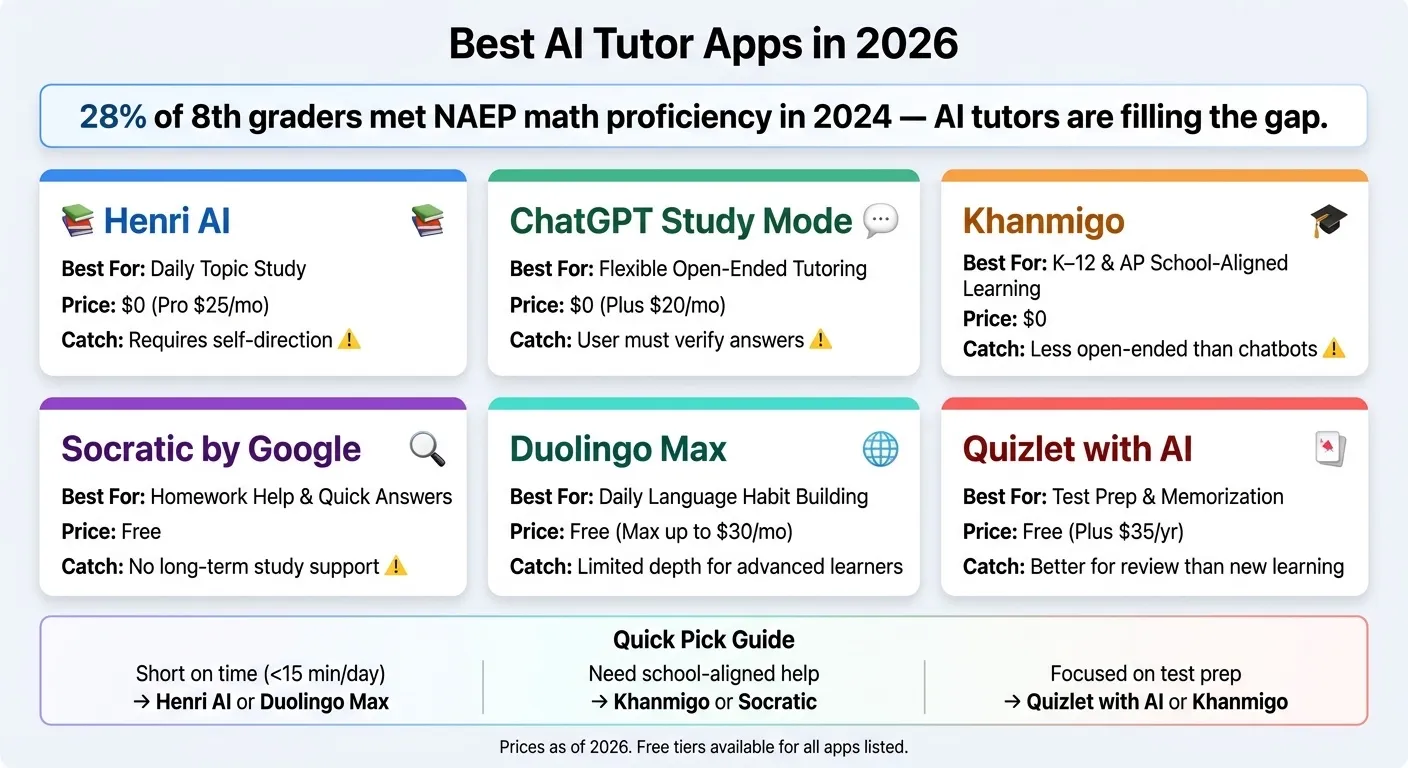
Quick Comparison
| App | Best for | Main format | Main catch | Price starting at |
|---|---|---|---|---|
| Henri AI | Daily topic study | Chat lessons, visuals, quizzes | You need to guide your own study | $0 |
| ChatGPT Study Mode | Flexible tutoring | Text and voice chat | You need to verify answers and plan your study | $0/month |
| Khanmigo | K–12 and AP learning | Guided chat inside Khan Academy | Less open-ended than a general chatbot | $0 |
| Socratic by Google | Homework help | Question-based explanations | Not built for long study plans | $0 |
| Duolingo Max | Daily language habit | Short drills and AI chat | Less depth for advanced output | Free; Max up to $30/month |
| Quizlet with AI | Test prep and vocabulary | Flashcards, Q-Chat, review modes | Better for review than first-time learning | Free; Plus $35/year |
If I were choosing fast, I’d use this rule:
- pick Henri AI for <u>topic-based daily study</u>
- pick ChatGPT when you want to ask follow-up questions
- pick Khanmigo when you want schoolwork tied to class material
- pick Socratic when you are stuck on one problem
- pick Duolingo Max when your main goal is a daily language streak
- pick Quizlet when you need facts, terms, and repetition
That’s the whole article in plain English: each app does one job better than the others, and the right one depends on how you study.
1. Henri AI
Primary Use Case
Henri AI is built for daily microlearning. It works well for curious learners who want to study topics like Stoic philosophy, art history, AI, or space exploration in short, focused sessions [7].
If you like learning in small chunks instead of sitting through a long course, Henri gives you a clear way to stick with one topic and build your knowledge bit by bit.
Lesson Format
Learning starts when you give Henri a topic or goal. It then creates a custom, chapter-by-chapter syllabus and teaches through conversation.
The lessons aren’t just blocks of text. Henri also uses diagrams, concept maps, and interactive visuals to help explain ideas. To help things stick, it adds smart quizzes for active recall and knowledge cards that sum up the main points for later review [7].
Personalization Depth
Henri adjusts to your knowledge level during onboarding, so the starting point feels more in line with what you already know. It also tracks progress each day, which makes it easy to stop and come back later without losing your place.
On supported iPhones, syllabus generation progress appears in the Dynamic Island and on the Lock Screen [7].
Pricing and Platforms
Henri is available on iPhone (iOS 18.0+), Mac (Apple M1 chip or later, macOS 15.0+), and Apple Vision (visionOS 2.0+) across Apple devices [7].
| Plan | Price | Trial |
|---|---|---|
| Free Tier | $0 [7] | Usage limits and access to basic features |
| Single Course | $15.00 [7] | - |
| Henri Pro | $25.00/mo [7] | 3-day free trial |
| Henri Max | $40.00/mo [7] | 3-day free trial |
Henri was developed by Xmind Ltd. It supports nine languages: English, Arabic, French, Japanese, Korean, Portuguese, Simplified Chinese, Spanish, and Traditional Chinese [7].
Next, look for an app that serves a different study style and learning goal.
2. ChatGPT Study Mode
Primary Use Case
ChatGPT Study Mode fits learners who want open-ended help and room for follow-up. Instead of moving through fixed lessons, you use prompts to turn it into a tutor that bends to what you need at that moment.
It works well when a concept just isn’t clicking and you want it explained in a different way. It’s also handy for brainstorming, study notes, and research help. You can ask it to explain the same idea with analogies or in simpler language, which can make a dense topic feel a lot less intimidating [3][6][10].
You can even prompt it to act as a Socratic tutor. In that setup, it holds back the direct answer and pushes you to think through the problem on your own [3].
Lesson Format
The main format is chat, with both text and voice available for tasks like language practice. If you upload a syllabus or class notes, ChatGPT can help map out a study schedule. It can also make multiple-choice quizzes from your notes on demand, walk through problems step by step, and handle follow-up questions when you miss something [8][9][10].
Some plans also include study reminders.
Personalization Depth
One of the big draws here is how much you can steer the explanation. You can ask for a version “like I’m in high school” or ask for a graduate-level breakdown of the exact same topic. ChatGPT then shifts its tone, depth, and framing based on your prompt [3][10].
That said, it helps with the material itself, but you still need to manage the larger study plan [9].
Use it for first-pass explanations and quiz generation. For advanced topics or subjects that change fast, check its answers against your course materials or primary sources.
Pricing and Platforms
ChatGPT is available on the web, iOS, and Android, with text and voice interactions [3][9].
| Plan | Price | What You Get |
|---|---|---|
| Free Tier | $0/mo | Basic chat and general tutoring [6] |
| Plus/Pro | $20/mo | Advanced models and higher usage limits [8][9] |
3. Khanmigo
Primary Use Case
Khanmigo is built for classroom-aligned learning, which makes it a strong option for K–12 students and AP-level coursework. It works best for learners who want school-focused help, not a freeform study chatbot.
Because it’s built into Khan Academy’s school-aligned curriculum, the tutoring stays connected to class goals. Its guided-question approach keeps students on track and walks them to the answer step by step. That structure is a big plus for students who do better with a clear path than with total freedom.
Lesson Format
Khanmigo uses chat-based coaching on top of Khan Academy’s content library. It covers math, science, reading, writing, and computer science, with step-by-step help across more than 70,000 practice problems [11].
When students get stuck, it doesn’t just hand over the answer. Instead, it uses guided prompts to help them work through the problem on their own.
It also helps with reading comprehension by summarizing texts, explaining hard passages, and quizzing students on what they read [3].
Personalization Depth
Khanmigo uses topic-by-topic mastery, so students don’t move ahead until they master the current skill. The platform adjusts difficulty in real time based on student progress [3]. Teachers can also use it to create daily study plans for grade-level work or AP goals [11].
That said, the personalization is tied to the curriculum, not open-ended chatting. You’re moving through a structured learning path, not steering the session wherever you want.
Pricing and Platforms
Khanmigo is listed at $0 for independent learners, teachers, and parents, with district access available through school partnerships [3][1][11].
| Plan | Price | Access |
|---|---|---|
| Independent Learner | $0 | Khanmigo AI tutoring [3][1] |
| District/School | Varies | Access through school partnerships [11] |
Next, we’ll look at an app built for fast, open-ended tutoring across many subjects.
4. Socratic by Google
Primary Use Case
Socratic is made for fast homework help and quick concept checks when you hit a wall. It works best when you need a clear explanation right away, not a full study plan.
Lesson Format
You submit a question, and Socratic walks through the idea behind the answer step by step[6]. The app tailors each reply to the exact prompt you ask, so the help is tied to that one question.
Pricing and Platforms
Socratic by Google is free on iOS and Android[6]. It’s built for quick, on-the-go use on both platforms.
| Feature | Details |
|---|---|
| Pricing | Free |
| Platforms | iOS and Android |
| Best For | Homework help and quick concept clarification |
| Personalization | Tailored to each question |
For language practice, the next app moves away from homework help and toward conversation and repetition.
5. Duolingo Max
Primary Use Case
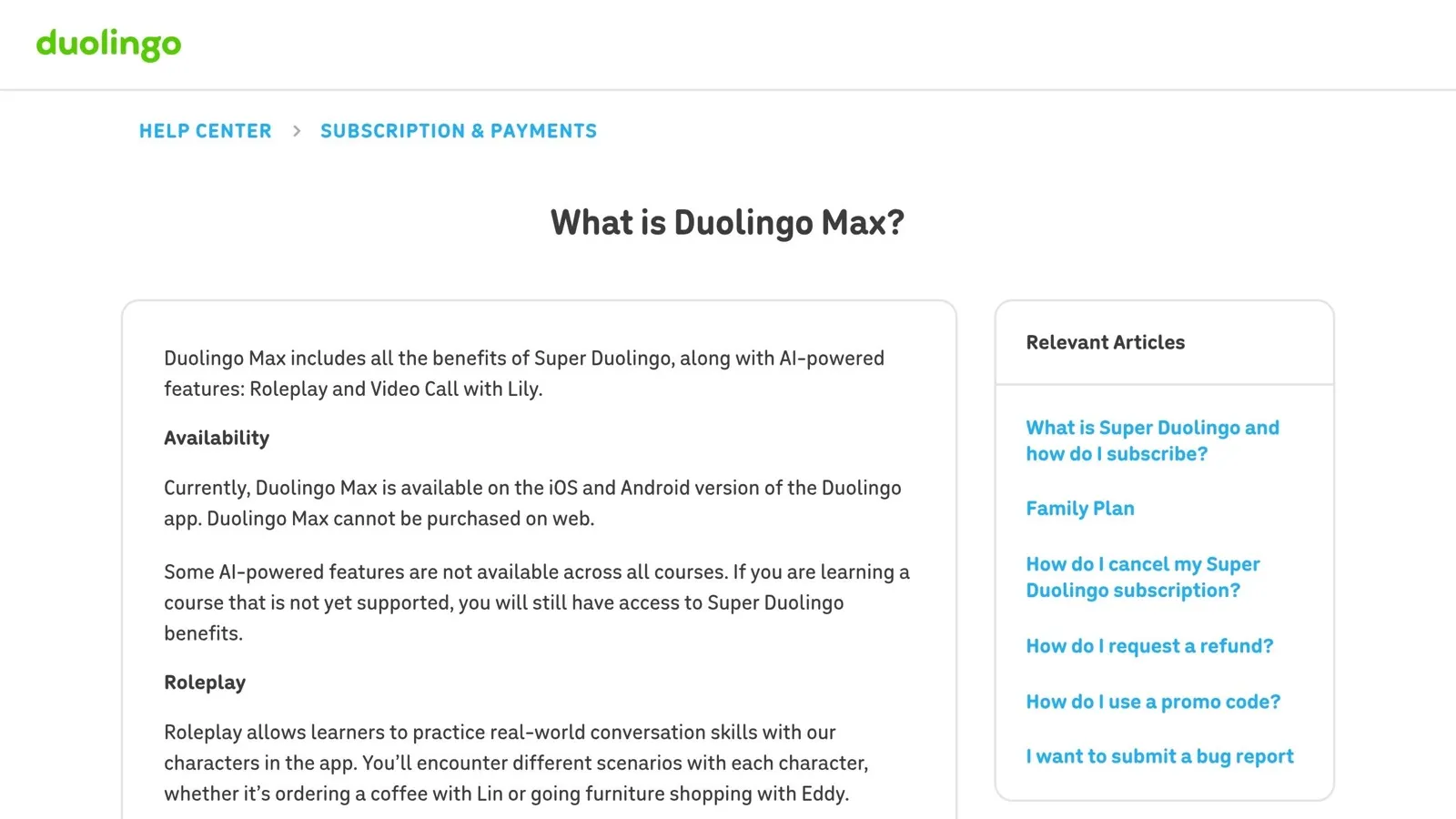
Duolingo Max works best for beginners who want to build a steady daily language habit. It’s the kind of app that helps you show up every day and get a little practice in.
That said, many learners hit a ceiling once they get past the basics. So while it’s useful for daily practice, it’s not the best pick for deep grammar study. Think of it as a daily warm-up, not a full tutoring solution.
Lesson Format
Lessons are short and game-like. You tap, match, and speak your way through drills built around streaks and rewards.
The Max tier adds AI-driven conversation practice, which gives you a repeatable conversation partner. You can go over phrases as many times as you need [3]. That repetition can help, especially when you’re still trying to get common words and sentence patterns to stick.
Personalization Depth
The app adjusts to your performance with a spaced-repetition model. It tracks how likely you are to remember each word based on your past activity [5].
It also changes difficulty based on accuracy. But there’s a catch: the app is better at training recognition than helping you build original sentences from scratch. For anyone trying to move past a conversational beginner level, that limit matters.
Pricing and Platforms
For most users, the main tradeoff is simple: habit-building convenience versus limited depth.
Duolingo is available on iOS and Android. The free tier includes ads and limited hearts. Super Duolingo costs about $7/month [2], while the Max tier can run up to $30/month [3].
| Feature | Details |
|---|---|
| Pricing | Free; Super about $7/mo; Max up to $30/mo |
| Platforms | iOS and Android |
| Best For | Beginners building a daily language habit |
| Personalization | Spaced repetition, adaptive difficulty |
Its scale points to strong habit-building appeal, but not deeper language mastery.
Next up: a tool built for active recall and study sets.
6. Quizlet with AI
Primary Use Case
Quizlet is the clearest pick for recall-heavy studying. It works best for test prep, vocabulary, and certifications. Use it to reinforce what you’ve already learned, not to teach a topic from scratch. That’s why it works so well when memorization matters more than instruction.
Lesson Format
At its core, Quizlet runs on digital flashcards. Q-Chat quizzes you and breaks down tough terms in simpler language, while Learn mode adjusts based on what you get wrong. It’s smart to search the library before building anything yourself, since many decks already exist. That mix of a huge deck library and adaptive review is what makes Quizlet so handy at scale.
Personalization Depth
Quizlet uses spaced repetition to bring back missed terms at set intervals, which helps fight the forgetting curve. Its AI can also turn your uploaded content into practice questions, saving you from making every card by hand.
Pricing and Platforms
The free tier includes ads and limits some AI study modes. Quizlet Plus costs $35/year [4] and includes AI-powered study modes, offline access, and image uploads.
| Feature | Details |
|---|---|
| Pricing | Free (ads, limited AI); Plus $35/year |
| Platforms | Web, iOS, Android, browser extensions |
| Best For | Test prep, vocabulary, certifications |
| Personalization | Spaced repetition, adaptive Learn mode |
Next, match each app to a specific study goal.
Use-Case Recommendations and Tradeoffs
No app works for every study goal. The right pick depends on what you’re studying, how long you want to spend per session, and how much structure you want built in. This comparison makes those tradeoffs easier to see.
For independent topic study, Henri AI stands out. It works best when you want a built-in roadmap instead of staring at a blank page and figuring everything out yourself. The downside is simple: sessions tend to take more time than they do with most quick-review tools.
For daily habit-building, Duolingo Max is the best fit for language practice. It’s built to keep you coming back day after day. But there’s a tradeoff here too. It leans more toward engagement and recognition than full mastery.
For homework help, Socratic by Google is the go-to option when you need a fast fix. That speed is useful, but it doesn’t do much for long-term retention.
For exam prep, the right choice depends on what kind of studying you need. Quizlet with AI works best for material that depends heavily on memorization. Khanmigo makes more sense when you need to slow down and work through the core ideas before a test. The tradeoff with Khanmigo is pace - it’s thorough, but slower than flashcard-based review.
Use the table below to match your study goal with the best-fit app.
| Scenario | Best-Fit App | Notable Tradeoff |
|---|---|---|
| Independent Topic Study | Henri AI | Higher time commitment per session |
| Daily Microlearning | Henri AI | Requires self-direction; no gamified habit scaffold |
| Daily Language Habit | Duolingo Max | Recognition-based tasks; less production practice |
| Homework Help | Socratic by Google | Minimal long-term retention support |
| Test Prep | Quizlet with AI | AI-generated content needs review |
| STEM & Coding Mastery | Khanmigo | Slower pace; less suited for quick review |
| Language Learning | Duolingo Max | Recognition-based tasks; less production practice |
Pros and Cons
Each app has a clear upside and a clear catch. The table below boils down the main tradeoff for each one.
| App | Biggest Strengths | Main Limitations |
|---|---|---|
| Henri AI | Personalized onboarding, custom syllabus generation, chapter-by-chapter learning plans, active recall practice, visual learning support, conversational tutoring | Requires self-directed study |
| ChatGPT Study Mode | Brainstorming, research assistance, and drafting study notes | Depends on user prompts and verification |
| Khanmigo | Deep, structured knowledge graphs for mastery learning | Works best inside a structured curriculum |
| Socratic by Google | Fast, step-by-step explanations tied to the exact question asked | Limited support for deeper study |
| Duolingo Max | Habit-building streaks, spaced repetition, AI conversation practice | Less effective for advanced production practice |
| Quizlet with AI | Q-Chat guides students to answers rather than just providing them; Smart Grading focuses on conceptual understanding rather than perfect typing [12] | Better for review than first-time learning |
Conclusion
The best app comes down to your goal, your pace, and how you like to study. The table below makes the choice simple.
| Question | What to pick |
|---|---|
| How much time do you have? | Under 15 min/day → Henri AI, Duolingo Max; longer sessions → Khanmigo, Quizlet |
| Do you need visual learning support? | Yes → Henri AI |
| Do you want a custom study plan? | Yes → Henri AI (custom syllabus + chapter-by-chapter plans) |
| Who is the learner? | Grades 6–12 → Khanmigo, Socratic; College/Adult → Henri AI |
| What device do you use most? | Mobile-first → Henri AI, Duolingo Max; browser-friendly → Khanmigo, Quizlet |
| What’s your budget? | $0 → Khanmigo; paid personalized option → Henri AI |
Pick the app that fits your subject, schedule, and budget, then stick with it.
Frequently asked questions
How do I choose the right AI tutor app for my study goal?
Start with your main study task, not a feature list. Pick the app based on what you need to do: retrieval tools for memorizing facts, practice tools for test prep, organization tools for structuring course notes, or AI-generation tools if making study materials eats up too much time. Then line it up with how you learn. Go with microlearning if you want a daily habit, active-production tools for language fluency, and apps that work smoothly with your existing PDFs, notes, or textbooks.
Which AI tutor app is best for self-paced daily learning?
For self-paced daily learning, Nibble stands out. It uses 10-minute interactive lessons across a range of subjects, so it fits neatly into a commute, a coffee break, or any small gap in your day. Each lesson works on its own and ends with a graded question, which gives you instant feedback. That simple setup keeps you involved instead of passively reading. It also makes daily study easier to stick with, which helps with long-term retention.
Are free AI tutor apps enough for serious studying?
Free AI tutor apps can be a solid fit for daily practice, habit-building, and learning specific subjects. They’re often enough for routine study sessions, especially if you want help staying consistent. Whether they’re enough for serious studying comes down to your goals and how hard you plan to push. If you’re reviewing core concepts, practicing a language, or brushing up on math, free versions can do the job well. For a lot of learners, that’s plenty. But in tougher fields like nursing, medicine, or advanced STEM, free plans can start to feel tight. Paid upgrades often open up things like progress tracking, ad-free studying, and more advanced AI tutoring.