
Henri Blog
How AI Is Transforming Microlearning (And What's Next)
How short, AI-driven lessons, spaced review, and adaptive quizzes boost retention, engagement, and personalized learning paths.
By Henri · Updated
AI microlearning works because it turns study into short sessions, custom review, and active recall. In plain terms: instead of sitting through long lessons, I can learn in 3-to-5-minute bursts, get tested on what I know, and review material right before I’m likely to forget it.
Here’s the short version:
- Short lessons cut overload
- AI changes the next step based on my answers
- Spaced review helps memory last longer
- Practice questions do more than measure learning - they build it
- This works well for languages, exam prep, and job training
- The next step is better tutors, mixed media lessons, and deeper personal tuning
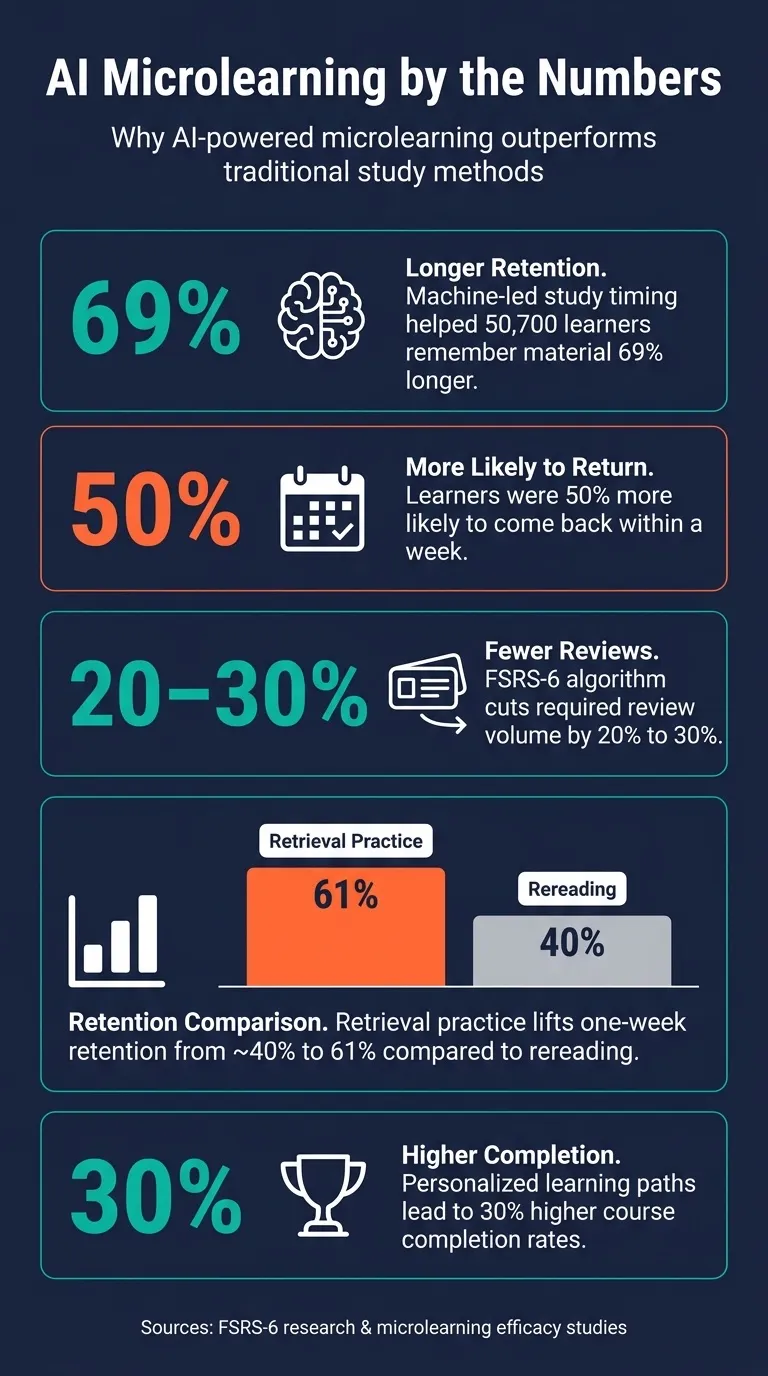
A few numbers stand out:
- In a study of 50,700 learners, machine-led study timing helped people remember material 69% longer
- The same study made learners 50% more likely to return within a week
- FSRS-6 can cut review volume by 20% to 30%
- Retrieval practice can lift one-week retention from about 40% to 61%
- Personalized learning paths can lead to 30% higher course completion
What this means for me is simple: AI microlearning is not just “short content.” It’s a system. It combines timed review, short quizzes, feedback, and lesson order so I spend less time rereading and more time recalling.
If I want a tool like this, I should look for:
- Short lesson design
- Review timed to forgetting
- Feedback after each mistake
- Chat-based help
- A study path that shifts with my progress
The big idea: AI is changing microlearning from a fixed set of mini lessons into a study loop that reacts to what I know, what I miss, and what I’m close to forgetting.
What AI-powered microlearning is today
AI-powered microlearning uses short lessons that shift with the learner in real time. What makes it useful is the way it builds on itself: each session gives the system more context, so the next one can fit better. Traditional microlearning usually puts everyone through the same sequence. AI-driven microlearning does something different. It tracks what you know, what you miss, and what slows you down, then changes what comes next based on your actual progress [5].
In day-to-day use, this often looks pretty simple. You might see:
- Flashcards
- Short quizzes
- Brief explainers
- Chat prompts
- Quick review sessions
That’s especially common when lessons come through a chat interface or a guided prompt [2][6][1]. The format isn’t the main thing. What matters is how the system responds after each answer.
Each response gives the system a signal. It uses those signals to spot gaps and adjust the next lesson [2][5]. If you’re moving through a concept with no trouble, the AI goes forward. If you’re stuck on something - like a grammar rule or a technical process - it picks up on the misses, spends more time there, and then speeds up again once you’ve got it [3].
Static microlearning makes lessons shorter. AI microlearning changes the lessons themselves.
From here, the next step is looking at how AI makes that shift happen: memory review, adaptive testing, and lesson sequencing.
The main AI techniques behind effective microlearning
Most AI microlearning runs on three core tools: review scheduling, adaptive quizzes, and automatic lesson building. In practice, these show up inside chat tutors and review systems that shift after every answer. From the learner’s side, it feels a lot like working with a tutor who remembers where you slipped, asks sharper questions, and brings weak spots back right when you need them.
Spaced repetition and review timed to forgetting
AI tools use algorithms to predict the best time to review each piece of information based on your past performance. The goal is simple: show the review just before you’re likely to forget. If you recall it with ease, the next review gets pushed farther out. If you miss it, the system brings it back sooner.
Many newer tools use algorithms like FSRS-6 (Free Spaced Repetition Scheduler), which is more accurate than the older SM-2 algorithm for most learners [7]. That extra accuracy has a direct payoff. Using FSRS can lead to 20% to 30% fewer reviews to reach the same retention level [7]. In plain English, that means less time grinding through what you already know and more time fixing what still needs work.
Adaptive quizzes and instant feedback
Adaptive quizzing checks what you know and changes the difficulty in real time. Get a question right, and the next one gets harder. Miss a concept, and the system lowers the difficulty, then explains why your answer was wrong instead of just stamping it incorrect.
That matters because of the testing effect. Students who practice retrieval keep about 61% of material after one week, compared with 40% for students who only reread [7]. So the quiz isn’t just checking memory. It’s part of the learning process itself. The instant, diagnostic feedback is what sets this apart from a basic multiple-choice test.
Custom lesson generation and smarter sequencing
AI can turn a PDF or transcript into short lessons, with each lesson built around one main idea. That makes the material easier to take in, especially in short study sessions. Some tools can also remake the same source material as diagrams, images, or annotated examples when a visual explanation works better.
It also helps with sequencing. AI can break source material into smaller lessons and arrange them by what you need to learn first, mapping prerequisites and building a path around your goal, whether that’s exam prep, a new skill, or language fluency. Personalized learning paths built this way can lead to a 30% higher course completion rate than standard training sequences [5].
These methods matter most when learners need fast feedback, short sessions, and a study path that changes in real time. That’s why they fit so well in language learning, exam prep, and skill building.
Where AI microlearning helps most
These tools matter most when people need practice, prep, or progress in short bursts. AI microlearning does its best work when the goal is fast practice, faster prep, or steady skill growth. That shows up in a few clear use cases.
Language learning and conversational practice
For language learners, AI works well as a low-pressure conversation partner that gives instant correction. You can practice without the stress that often comes with speaking to another person, which makes it easier to keep going.
Short, frequent sessions help vocabulary and grammar stick better than occasional long ones [4]. AI-powered spaced repetition brings back words and verb forms based on how you perform, so you review them before they start to fade.
Exam prep and academic study
AI can save a lot of time by turning lectures, notes, and source material into practice questions and review sets [1]. That gives students more room to focus on the kind of work that improves recall instead of spending hours building study materials from scratch.
The payoff is hard to ignore: learners who test themselves retain about 80% of material after a week, compared with about 35% for those who simply restudy [1]. AI-generated practice questions can also match the style and difficulty of real assessments using your own source material. So each quiz goes after the gaps most likely to hurt your score [1].
Professional upskilling and self-directed learning
In workplace training, speed matters. AI-assisted authoring tools can turn SOPs or PDFs into interactive micro-lessons in minutes [2]. That makes AI microlearning a strong fit for frontline workers in retail, logistics, and manufacturing who need short training bursts instead of long sessions [2].
Self-directed learners get a different kind of help. AI makes it easier to start, which is half the battle with hard topics. When a subject feels dense or messy, AI can build a custom syllabus, split heavy material into small chunks, summarize nonfiction into 15-minute key points, and use guided questioning to keep learners moving only when they can show understanding [2][6][8].
That same structure is shaping the next wave of AI tutors.
Henri AI and where microlearning is headed
How Henri AI turns spare minutes into structured learning
These methods work best when they connect into one loop instead of sitting off to the side as separate tricks.
Henri AI is built on a simple idea: short sessions should still lead to real progress. It starts with a quick diagnostic that builds a learning profile around your topic, current level, and preferred way of learning. From there, Henri AI maps concept dependencies, tracks progress in a knowledge base, and schedules review for the point when recall is most likely to fade.
Each session follows a structured Teaching Loop: explain → example → check understanding → evaluate → practice → review. That flow matters. It keeps the lesson moving, but it also makes sure you don’t just read something and move on.
One part stands out: the AI asks you to explain the concept back before you continue. That bit of friction is the point. It pushes active recall, which helps the material stay with you. Sessions can cover science, philosophy, creativity, life skills, and thinking tools in bite-size lessons built for the small pockets of time most people actually have.
What comes next: smarter tutors, multimodal lessons, and deeper personalization
The next step isn’t just shorter lessons. It’s better guidance.
Today’s AI microlearning is already useful, but the next wave will feel much sharper. One big shift is proactive tutoring: systems that bring up a concept before you forget it [1]. Future systems are expected to go even further by tracking subtle response patterns to predict when a learner is likely to forget next [1].
Content formats are changing too. Right now, most AI microlearning tools are still text-first. Near-future systems will work across video, audio, and diagrams at the same time, then build lessons that point to exact visual moments in a lecture [1]. Personalization is also set to go deeper. Instead of reacting only to quiz scores, these systems may tune explanations to a learner’s cognitive profile, preferred analogies, and long-term knowledge gaps [1].
Conclusion: how to get the most from AI microlearning
For learners, the takeaway is simple: the best AI microlearning tools match your pace, push you to recall ideas, and fit into the small gaps in your day.
Look for tools that offer:
- Short lesson design
- Adaptive review
- Clear feedback on mistakes
- Conversational support
- A learning path that changes as your knowledge changes
The goal isn’t to make learning easy. It’s to make the right kind of effort easier to keep up.
Frequently asked questions
How does AI know what I should review next?
AI figures out what you should review next by looking at your performance data and spotting knowledge gaps. It tracks your accuracy and response times, then uses spaced repetition to estimate when you’re most likely to forget a concept and schedules review right as that memory starts to fade. If you keep struggling with a topic, the AI marks it for more frequent review until your results improve. Some systems also compare performance across subjects or decks so they can put your weakest areas at the front of the line.
Can AI microlearning help if I only have a few minutes a day?
Yes. AI microlearning fits short study sessions, so it works well even if you only have a few minutes a day. It breaks topics into bite-sized lessons, short quizzes, and interactive conversations. That means you can keep moving forward without setting aside long study blocks. Tools like Henri can also build custom syllabi and create content on demand. So instead of spending your limited time figuring out what to study, you can jump straight into the lesson and make those short sessions count.
What features should I look for in an AI microlearning tool?
Look for tools that put learning that adjusts to each person and measurable retention first. Key features include: AI-assisted authoring that turns PDFs or SOPs into bite-sized lessons and quizzes Spaced repetition to spot knowledge gaps and retest learners until mastery Real-time, context-aware tutoring tied to the material a learner is reviewing