
Henri Blog
AI Microlearning: The Future of Personalized Training
Short AI-driven lessons using spaced repetition, active recall, and adaptive sequencing to boost retention and cut training time.
By Henri · Updated
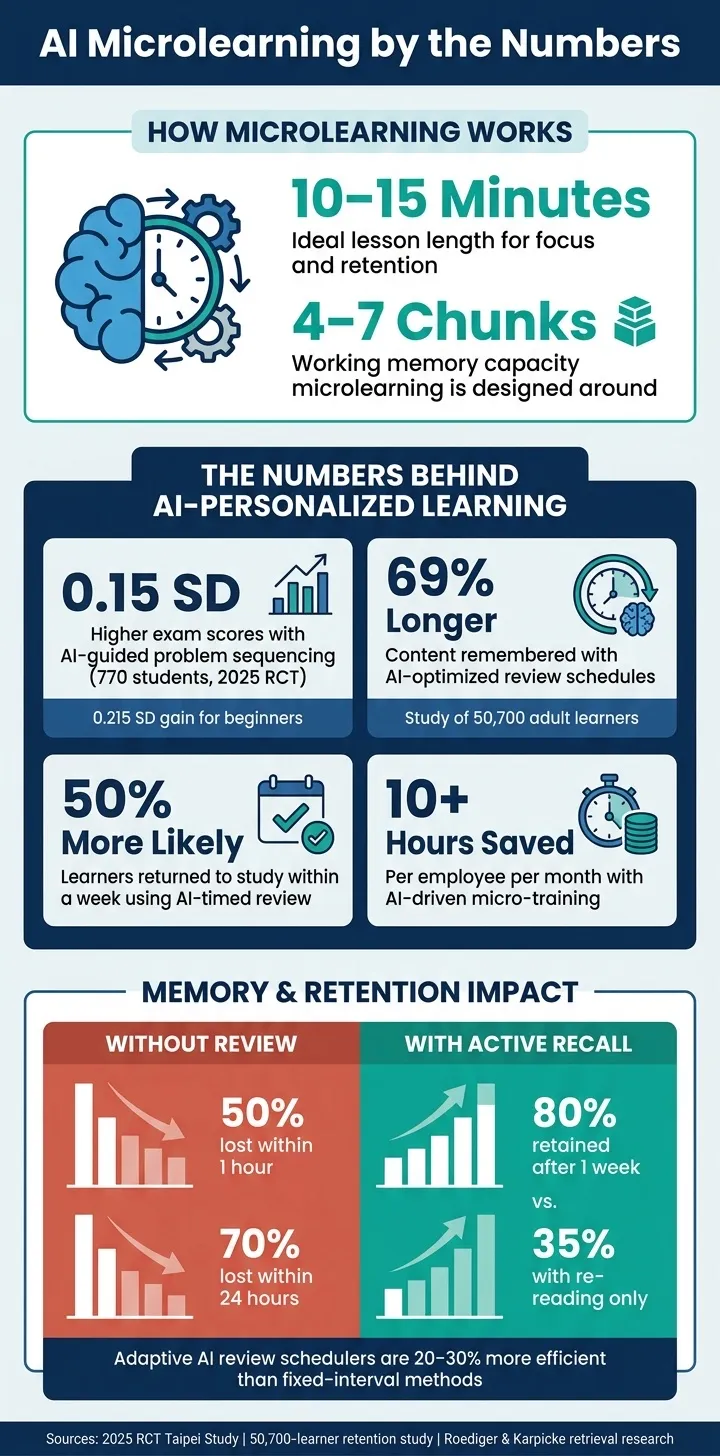
AI microlearning works because it gives you short lessons, tests your memory, and brings back what you’re likely to forget. Instead of sitting through long training, you study in 10–15 minute blocks, get instant feedback, and follow a lesson path shaped by your answers, speed, mistakes, and review history.
Here’s the short version:
- Microlearning keeps lessons short, which helps reduce mental overload.
- AI personalization changes the next lesson based on what you know and where you get stuck.
- Active recall makes you answer questions from memory instead of just rereading notes.
- Spaced repetition schedules review before you forget too much.
- Question-first tutoring helps you think before the AI explains.
- Source-to-study tools can turn PDFs, notes, slides, and meeting docs into quizzes, flashcards, and lesson sets.
- Human review still matters for high-stakes topics because AI can sound sure even when it’s wrong.
A few numbers stand out. One 2025 study found AI-guided problem sequencing led to 0.15 standard deviation higher exam scores, with bigger gains for beginners at 0.215. Another large study of 50,700 adult learners found AI-timed review helped people remember content 69% longer and made them 50% more likely to come back within a week.
If I had to boil the whole article down to one idea, it would be this: the future of training is not longer courses - it’s shorter lessons, better timing, and more memory practice.
What AI Microlearning Is and How It Improves Personalized Training
Microlearning: Short Lessons Built for Focus and Retention
Microlearning breaks content into small, focused units that people can finish in 10 to 15 minutes [1][9]. That length fits the limits of working memory, which can hold about 4 to 7 chunks of information at once [1]. In plain English, it helps cut cognitive overload. It also makes lessons simple to start, pause, and pick back up on a phone.
That setup becomes even more useful when AI uses each short lesson to zero in on the learner’s next weak spot.
How AI Adapts Each Lesson to the Learner
The system tracks correct answers, response time, repeated mistakes, and hint requests. From there, it builds an up-to-date picture of what each learner knows and where they get stuck [1][8]. Models such as Bayesian Knowledge Tracing and Item Response Theory can change question difficulty, reorder content, and schedule reviews based on the learner’s current skill level [1].
If someone keeps missing the same kind of question, the system slows down and revisits that gap before moving on. That means less time spent on material the learner already knows, and less chance of skipping over what still needs work.
Prior knowledge is one of the strongest signals for what a learner is likely to absorb next. It explains a large share of learning outcomes [1]. That’s why systems that check what a learner already knows before building a learning path often work so well.
This is why the format fits students, employees, and trainers who all have different goals.
Who Benefits Most from AI Microlearning
AI microlearning works for many types of learners, but it tends to help busy students and working adults the most. They need training that fits into a packed day, not something that demands an hour at a desk. Organizations using AI-driven micro-training report saving more than 10 hours per employee each month [7].
Workplace trainers and educators gain from it too. Instead of building one course for everyone and hoping it fits, they can use AI to adjust difficulty, pacing, and content to match each learner’s role, gaps, and goals [5].
How AI Personalizes Microlearning in Practice
Here’s what that looks like day to day.
Tracking Knowledge Gaps and Adjusting Difficulty
AI can compare a learner’s free-response answer against an expert model, sort errors into recall, reasoning, or application failures, and use response time along with repeat mistakes to decide what comes next [3][6][13].
When the system spots a gap, it slows things down, returns to the weak area, and uses adaptive sequencing to increase difficulty only after the learner shows steady success [13]. A 2025 randomized controlled trial with 770 high school students in Taipei found that students using AI tutors with personalized problem sequencing scored 0.15 standard deviations higher on final exams. Researchers compared that gain to 6 to 9 months of additional schooling [13]. Beginners improved the most, with gains of 0.215 standard deviations [13].
There’s one risk here that’s easy to miss: polished AI explanations can make people feel like they understand something when that feeling disappears the moment they have to solve the problem on their own [3][6]. That’s why question-first tutoring matters. It pushes retrieval instead of passive reading.
Building Custom Learning Paths from Notes, Lectures, and Goals
Most learners already have the raw material sitting in front of them - lecture slides, PDFs, or handwritten notes. AI can turn that pile into chapter-by-chapter study sequences, quizzes, and flashcard sets built around a clear goal.
At the center of this process is skill mapping. The AI breaks a subject into smaller skills or concepts, then sequences them based on what the learner needs to learn first [1]. Henri AI, for example, builds custom syllabi from a user’s topic and goal, turning the subject into structured lessons with interactive knowledge cards that carry over between sessions [2]. The same setup can turn lecture notes, PDFs, or meeting materials into short practice sessions.
Let AI handle the formatting and sequencing. The learner should still do the hard part: solving the problems.
Conversational Tutoring and Guided Problem Solving
The best AI tutors don’t rush to hand over the answer. They ask questions. That Socratic style keeps the learner doing the heavy mental work. Instead of starting with a full explanation, a well-built AI tutor asks what the learner already knows, then probes the weak spots with follow-up questions.
“The tutor does not lecture. The tutor listens, identifies the student’s specific confusion, and intervenes at exactly the point where intervention matters.” - Arthur Graesser, Researcher [11]
Still, conversational AI tutoring has limits. LLMs can sound sure of themselves while getting things wrong, especially in advanced subjects or fast-moving fields. For anything high-stakes or changing fast, treat AI output as a starting point and check it against primary sources like textbooks or official documentation [6]. In those cases, human oversight is not optional.
Use AI for pacing, prompts, and practice. Keep humans in the loop for review and high-stakes judgment.
Once the system can adjust to gaps and goals, the next move is making each short lesson stick.
The Learning Strategies That Make AI Microlearning Work
Once AI knows what a learner needs, the next step is helping that learning last. That’s where AI microlearning pulls its weight. It takes care of the parts of studying that people often struggle to manage on their own: when to review, what to practice, and how fast to move.
Spaced Repetition for Long-Term Retention
Without review, learners typically lose about 50% of new information within the first hour and up to 70% within 24 hours [16]. Spaced repetition pushes back on that by scheduling review sessions at increasing intervals, which helps interrupt the forgetting curve before too much slips away [16].
AI makes this far easier to use in daily study. Instead of asking learners to track every review by hand, the system sets the schedule on its own. It adjusts review frequency based on each learner’s recall history and puts extra focus on items they’ve missed [2][14]. In plain English: if you keep forgetting something, AI brings it back sooner. If you know it well, it backs off. Adaptive review schedulers are 20% to 30% more efficient than older fixed-interval methods, saving hundreds of hours of review time each year [1].
Active Recall Through Questions, Flashcards, and Short Practice
Once AI maps out the learning path, active recall checks whether the learner can bring that knowledge back when needed. Passive review helps with recognition - spotting information when you see it. Active recall is different. It trains you to pull the answer out of your own memory.
That difference matters. Research by Roediger and Karpicke found that students who practiced retrieval retained approximately 80% of material after one week, compared with about 35% for those who only restudied [6][17].
AI helps by turning source material - lecture notes, PDFs, or uploaded readings - into quizzes, flashcards, and short practice questions [6][17]. So instead of burning time setting up study materials, learners can get straight to the part that counts: recalling the information.
A small habit can push this even further. Before asking AI to explain something, spend about 90 seconds writing down what you already know from memory. That first retrieval attempt gives your brain something to work with before the system fills in the missing pieces [6].
Focused Micro-Lesson Design with Instant Feedback
Spaced repetition and active recall work best when each lesson stays narrow in scope. A strong micro-lesson includes one clear goal, one small chunk of content, one short practice task, and immediate feedback. That setup fits the limits of working memory, which is roughly four to seven chunks of new information at one time [1].
Short lessons also need to fit into a larger path. Otherwise, they can feel like random fragments. AI can use mastery learning to move learners ahead only after the current concept is solid [14][10]. And when feedback is instant, learners don’t have to guess what went wrong. They can see exactly where their reasoning broke down and fix it on the spot.
Tools and Real Use Cases for AI Microlearning
These learning methods don’t just sit in theory. They show up in apps people use every day, often in short sessions that fit between meetings, classes, or a commute.
Henri AI: Everyday Bite-Sized Learning and Conversational Tutoring
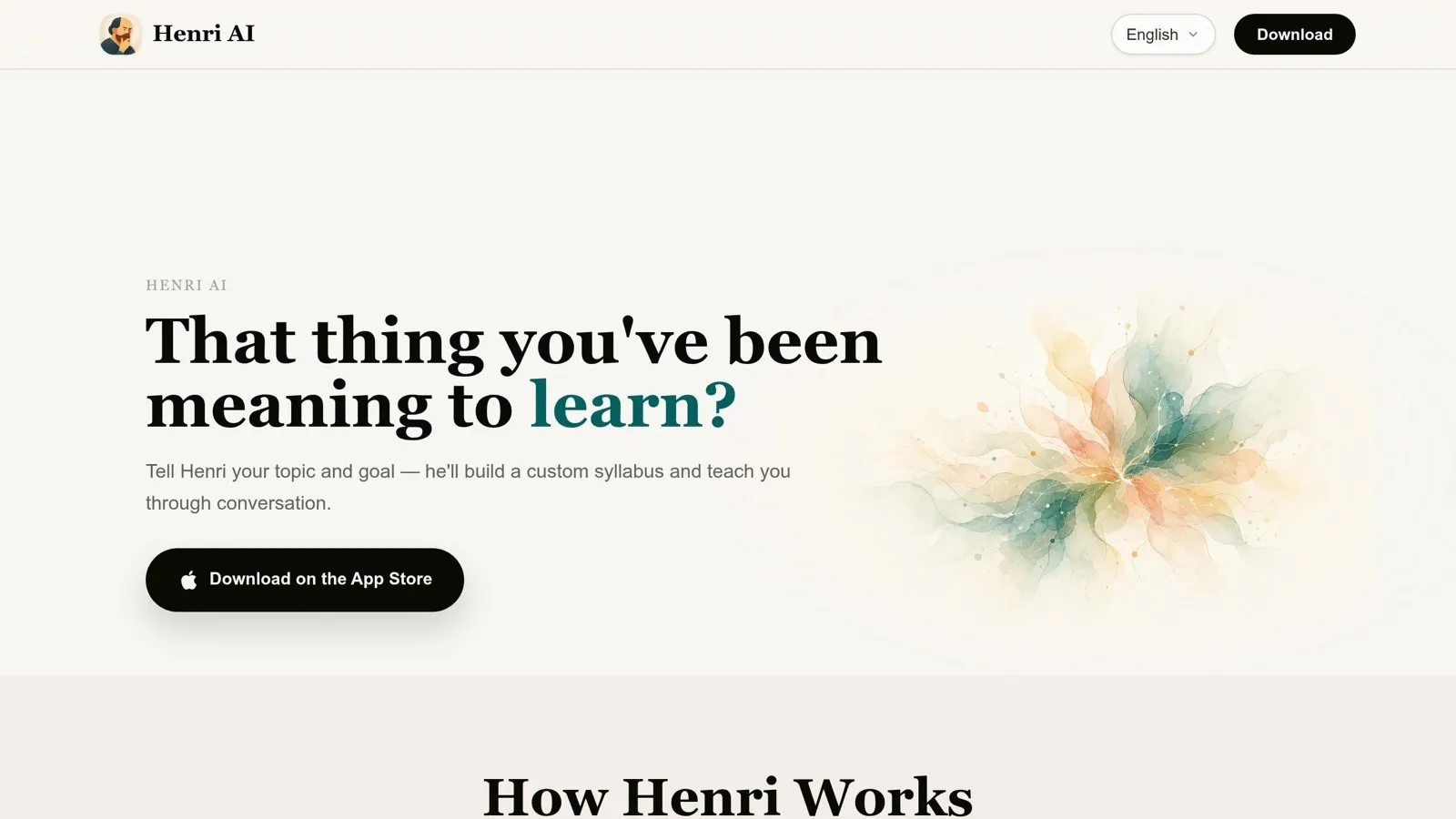
Henri AI is built on a simple idea: learning should fit into your day, not the other way around. It begins with a short onboarding chat that sets your topic, level, and goals. From there, it builds a custom, chapter-by-chapter syllabus around what you want to learn [2].
Lessons unfold through guided dialogue. The AI explains a concept, checks whether you understand it, and changes the next step based on your response. If a topic needs a visual aid, it can bring in diagrams and concept maps to help make the idea stick [2]. At the end of each lesson, the material turns into quizzes and knowledge cards that carry into the next session [2]. The iPhone app is built for mobile use and covers subjects ranging from memory science and Stoic philosophy to economics and space exploration [2].
How Each Named Tool Applies AI Microlearning Differently
These examples point to four common patterns: conversational tutoring, guided practice, retrieval, and spaced review.
Duolingo Max simulates realistic conversations at the learner’s CEFR level and keeps a “List of Facts” about each user so those exchanges feel more relevant to the person using it [12]. As the Duolingo Blog put it:
“To develop AI-powered features like Video Call with Lily, we can’t just let the model roam freely. Instead, we use targeted instructions and a predictable structure.” [12]
Khanmigo uses guiding questions to help students work through problems and spot misconceptions on their own, across K–12 subjects such as math and writing [10].
Quizlet AI adjusts to your study set and uses FSRS-based scheduling to focus on what you’re most likely to forget [1].
ChatGPT-based study assistants can turn passive reading into a study loop built around short explanations, self-quizzing, and follow-up questions that push retrieval instead of simple exposure [3][11].
Practical Workflows for Learners, Educators, and Workplace Trainers
Once the tools make sense, the next move is building a study routine you can repeat without much friction.
A self-directed learner might spend a few minutes each day on a Henri AI lesson, then review that session’s knowledge cards later the same day or the next morning [2]. An educator can use a ChatGPT-based assistant to turn a chapter into a short concept guide in minutes, then use that guide as the base for a recap module before class [4]. A workplace trainer can send short skill refreshers during the workday, then use performance data to spot gaps and trigger follow-up practice [1][15].
The pattern is pretty simple. Start with the learner’s goal, then let the AI decide what should come next.
Conclusion: What Personalized Training Looks Like Going Forward
Taken together, these methods point to a simpler model for training. The big shift isn’t more content. It’s better timing.
AI microlearning brings adaptive difficulty, conversational tutoring, spaced repetition, and active recall into a learning loop that adjusts to each learner in real time.
The results are hard to ignore. In a study of 50,700 adults, learners using AI-optimized review schedules remembered content 69% longer and were 50% more likely to return to studying within a week [8].
AI takes care of scheduling, formatting, and gap detection, so learners can spend more time on retrieval, problem-solving, and explanation [6]. That changes personalized training from a big content library into a system shaped around learner goals, pace, and retention.
In Henri AI, that means shorter lessons, smarter review, and feedback that matches the learner’s pace.
That’s where training is heading: shorter lessons, better timing, stronger retention.
Frequently asked questions
How is AI microlearning different from regular online training?
AI microlearning goes beyond a static, one-size-fits-all model. Instead of giving every learner the same material, it breaks topics into short lessons and adjusts them based on each person’s pace, knowledge gaps, and performance. It also puts active learning front and center through spaced repetition and retrieval practice, with real-time feedback and custom learning paths. That means learners spend more time on what they need most, which helps improve retention while cutting training time.
Can AI microlearning work for complex or high-stakes subjects?
Yes. AI microlearning can work well for complex, high-stakes subjects when you use it as an active study system, not a passive source of information. The big shift is simple: instead of just reading or watching, the learner has to do something with the material. AI can split dense topics into smaller chunks, then guide practice in a way that keeps the brain engaged. That matters because hard subjects usually don’t fall apart from lack of exposure. They fall apart when people think they understand something, then freeze when they have to recall it, apply it, or explain it under pressure. Used well, AI microlearning helps with that by combining a few proven study methods: Retrieval practice to force recall instead of passive review Spaced repetition to bring material back at the right time Tailored dialogue to surface confusion and push the learner to explain their reasoning In plain English, it helps people find weak spots sooner, test memory when the stakes feel higher, and build deeper retention by explaining why an answer makes sense, not just what the answer is.
What’s the best way to use AI microlearning every day?
Build a simple, active learning loop instead of treating AI like a one-way info dump. Start each session by saying your learning goal in your own words. Then ask your AI assistant for a short explanation. After that, explain the idea back from memory. No peeking. That’s where the learning starts to stick. Then use AI to check your grasp with questions and simple scenarios. This turns the session from passive reading into practice. It also helps to spread your practice across a few days. A little review over time does more for long-term memory than cramming everything into one sitting.